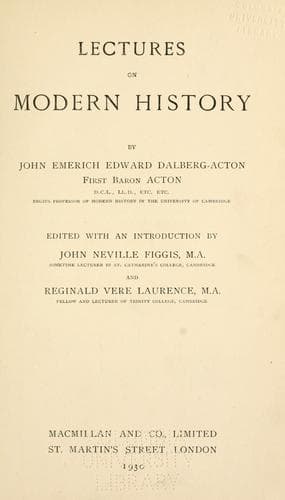
Lectures on Modern historyActon, John Emerich Edward Dalberg Acton, Baron
History
Lectures on Modern history
Acton, John Emerich Edward Dalberg Acton, Baron
History, Modern
The years which followed the Seven Years' War were a time of peace for
a great part of the Continent, in the course of which a memorable
change took place in European polity. It was the age of what may be
called the Repentance of Monarchy. That which had been selfish,
oppressive, and cruel became impersonal, philanthropic, and
beneficent. The strong current of eighteenth-century opinion left the
State omnipotent, but obliged it to take account of public, as
distinct from dynastic, interests. It was employed more or less
intelligently, for the good of the people. Humanity contended for the
mastery with ambition. It was still a despotism, but an enlightened
despotism. The competent expert more than ever was supreme, but he
was influenced by great writers--Locke, Montesquieu, Turgot, Beccaria,
Adam Smith. There was a serious tendency to increase popular
education, to relieve poverty, to multiply hospitals, to promote
wealth by the operations of the engineer, to emancipate the serf, to
abolish torture, to encourage academies, observatories, and the like.
Prisons had never been so bad--attempts were made to reform them. The
slave trade had never been so prosperous; people began to doubt
whether it was moral. Laws were codified, and though the codes were
surprisingly bad, the laws were improved by them. The movement was
almost universal, from Spain to Denmark and Russia. Piedmont dealt
successfully with the feudal and social question, which baffled the
National Assembly in France. The rich plain of the Milanese was
administered by a proconsul of Maria Theresa, in a manner which made
it the example of Europe. A strenuous disciple of the economists
governed Baden. Wuerzburg and Bamberg, under the last Prince Bishop,
were considered the happiest region in the empire. Turgot,
Bernstorff, Firmian, were admired and imitated as Lewis XIV had been
in a former phase of absolute monarchy. Society was enjoyable, apart
from politics, and was studied like a fine art in the homes of
luxury--Paris, Brussels, Rome, and Venice. Things went very well in
those days with any man who was not a Whig, and had no views as to
what makes governments legitimate and averts revolution.
Public-domain text, read in full here on John Shaqi.
Reviews
Reviews
No reviews yet
Be the first to share your thoughts on this work.
Elsewhere in the archive
Join the Discussion
Join the discussion
Sign in to leave a comment or review.
Sign InorCreate an account