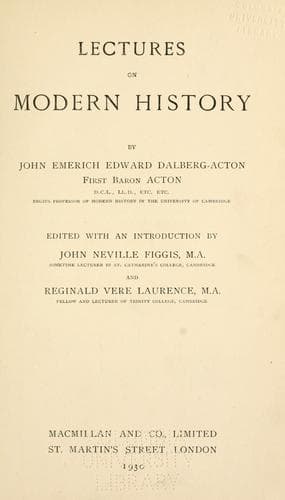
Lectures on Modern historyActon, John Emerich Edward Dalberg Acton, Baron
History
Lectures on Modern history
Acton, John Emerich Edward Dalberg Acton, Baron
History, Modern
pay less for the same commodity? To gild the pill still further, it
was proposed that the threepence should be levied at the British
ports, so that the Americans should perceive nothing but the gift,
nothing but the welcome fact that their tea was cheaper, and should be
spared entirely the taste of the bitterness within. That would have
upset the entire scheme. The government would not hear of it.
America was to have cheap tea, but was to admit the tax. The sordid
purpose was surrendered on our side, and only the constitutional
motive was retained, in the belief that the sordid element alone
prevailed in the colonies.
That threepence broke up the British empire. Twelve years of renewed
contention, ever coming up in altered shape under different ministers,
made it clear that the mind of the great parent State was made up, and
that all variations of party were illusory. The Americans grew more
and more obstinate as they purged the sordid question of interest with
which they had begun. At first they had consented to the restrictions
imposed under the Navigation Laws. They now rejected them. One of
the tea ships in Boston harbour was boarded at night, and the tea
chests were flung into the Atlantic. That was the mild beginning of
the greatest Revolution that had ever broken out among civilised men.
The dispute had been reduced to its simplest expression, and had
become a mere question of principle. The argument from the Charters,
the argument from the Constitution, was discarded. The case was
fought out on the ground of the Law of Nature, more properly speaking,
of Divine Right. On that evening of 16th December, 1773, it became,
for the first time, the reigning force in History. By the rules of
right, which had been obeyed till then, England had the better cause.
By the principle which was then inaugurated, England was in the wrong,
and the future belonged to the colonies.
The revolutionary spirit had been handed down from the
seventeenth-century sects, through the colonial charters. As early as
1638 a Connecticut preacher said: "The choice of public magistrates
belongs unto the people, by God's own allowance. They who have the
power to appoint officers and magistrates, it is in their power, also,
to set the bounds and limitations of the power and place unto which
they call them." In Rhode Island, where the Royal Charter was so
liberal that it lasted until 1842, all power reverted annually to the
people, and the authorities had to undergo re-election. Connecticut
possessed so finished a system of self-government in the towns, that
it served as a model for the federal Constitution. The Quakers of
Pennsylvania managed their affairs without privilege, or intolerance,
or slavery, or oppression. It was not to imitate England that they
went into the desert. Several colonies were in various ways far
ahead of the mother country; and the most advanced statesman of the
Commonwealth, Vane, had his training in New England.
Public-domain text, read in full here on John Shaqi.
Reviews
Reviews
No reviews yet
Be the first to share your thoughts on this work.
Elsewhere in the archive
Join the Discussion
Join the discussion
Sign in to leave a comment or review.
Sign InorCreate an account