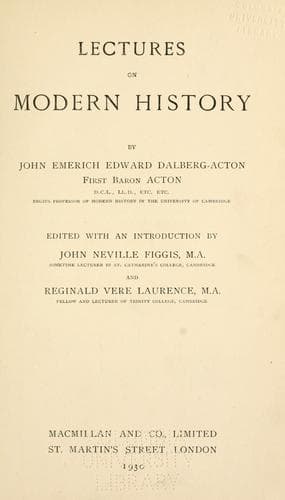
Lectures on Modern historyActon, John Emerich Edward Dalberg Acton, Baron
History
Lectures on Modern history
Acton, John Emerich Edward Dalberg Acton, Baron
History, Modern
After the outrage on board the Dartmouth in Boston harbour the
government resolved to coerce Massachusetts, and a continental
Congress met to devise means for its protection. The king's troops
were sent to destroy military stores that had been collected at
Concord; and at Lexington, on the outward march, as well as all the
way back, they were assailed by militia. The affair at Lexington,
19th April, 1775, was the beginning of the War of Independence, which
opened with the siege of Boston. Two months later the first action
was fought at Bried's Hill, or Bunker Hill, which are low heights
overlooking the town, and the colonials were repulsed with very little
loss.
The war that followed, and lasted six years, is not illustrious in
military annals, and interests us chiefly by the result. After the
first battle the colonies declared themselves independent. Virginia,
acting for herself only, led the way. Then the great revolutionist,
who was the Virginian leader, Jefferson, drew up the Declaration of
Independence, which was adopted by the remaining states. It was too
rhetorical to be scientific; but it recited the series of ideas which
the controversy had carried to the front.
Thirty thousand German soldiers, most of them from Hesse Cassel, were
sent out, and were at first partially successful; for they were
supported by the fleet, which the estuaries carried far inland. Where
the European army had not that advantage things went badly. The
Americans attacked Canada, expecting to be welcomed by the French
inhabitants who had been so recently turned into British subjects.
The attack failed dramatically by the death of General Montgomery,
under the walls of Quebec, and the French colonists remained loyal.
But an expedition sent from Canada against New York, under Burgoyne,
miscarried. Burgoyne had scarcely reached the Hudson when he was
forced to surrender at Saratoga. The Congress of the States, which
feebly directed operations, wished that the terms of surrender should
not be observed, and that the 5000 English and German prisoners,
instead of being sent home, should be detained until they could be
exchanged. Washington and his officers made known that if this was
done they would resign.
The British defeat at Saratoga is the event which determined the issue
of the conflict. It put an end to the vacillation of France. The
French government had to recover the position it had lost in the last
war, and watched the course of events for evidence that American
resistance was not about to collapse. At the end of 1777 the victory
of Saratoga supplied the requisite proof. Volunteers had been allowed
to go over, and much war material was furnished through the agency of
a comic poet. Now a treaty of alliance was concluded, a small army
was sent to sea, and in March 1778 England was informed that France
was at war with her. France was followed by Spain, afterwards by
Holland.
Public-domain text, read in full here on John Shaqi.
Reviews
Reviews
No reviews yet
Be the first to share your thoughts on this work.
Elsewhere in the archive
Join the Discussion
Join the discussion
Sign in to leave a comment or review.
Sign InorCreate an account