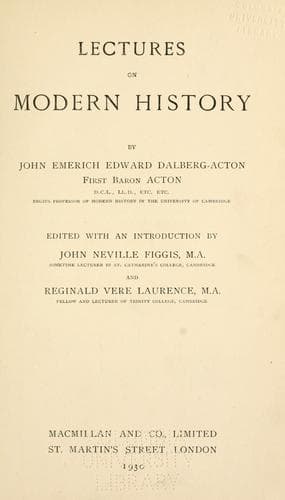
Lectures on Modern historyActon, John Emerich Edward Dalberg Acton, Baron
History
Lectures on Modern history
Acton, John Emerich Edward Dalberg Acton, Baron
History, Modern
We shall be glad if each contributor will send us, as early as he
finds it convenient, a preliminary catalogue of the works on
which he would rely; and we enclose a specimen, to explain our
plan, and to show how we conceive that books and documents might
be classified.
3. Our scheme requires that nothing shall reveal the country,
the religion, or the party to which the writers belong.
It is essential not only on the ground that impartiality is the
character of legitimate history, but because the work is carried
on by men acting together for no other object than the increase
of accurate knowledge.
The disclosure of personal views would lead to such confusion
that all unity of design would disappear.
4. Some extracts from the editor's Report to the Syndics will
show the principles on which the Cambridge History has been
undertaken.
"The entire bulk of new matter which the last forty years have
supplied amounts to many thousands of volumes. The honest
student finds himself continually deserted, retarded, misled by
the classics of historical literature, and has to hew his own way
through multitudinous transactions, periodicals, and official
publications, where it is difficult to sweep the horizon or to
keep abreast. By the judicious division of labour we should be
able to do it, and to bring home to every man the last document,
and the ripest conclusions of international research. . . .
"All this does not apply to our own time, and the last volumes
will be concerned with secrets that cannot be learned from books,
but from men. . . .
"The recent Past contains the key to the present time. All forms
of thought that influence it come before us in their turn, and we
have to describe the ruling currents, to interpret the sovereign
forces, that still govern and divide he world. . . .
"By Universal History I understand that which is distinct from
the combined history of all countries, which is not a rope of
sand, but a continuous development, and is not a burden on the
memory, but an illumination of the soul. It moves in a succession
to which the nations are subsidiary. Their story will be told,
not for their own sake, but in reference and subordination to a
higher series, according to the time and the degree in which they
contribute to the common fortunes of mankind. . . .
"If we treat History as a progressive science, and lean specially
on that side of it, the question will arise, how we justify our
departure from ancient ways, and how we satisfy the world that
there is reason and method in our innovations. . . .
"To meet this difficulty we must provide a copious, accurate, and
well-digested catalogue of authorities. . . . "
Public-domain text, read in full here on John Shaqi.
Reviews
Reviews
No reviews yet
Be the first to share your thoughts on this work.
Elsewhere in the archive
Join the Discussion
Join the discussion
Sign in to leave a comment or review.
Sign InorCreate an account