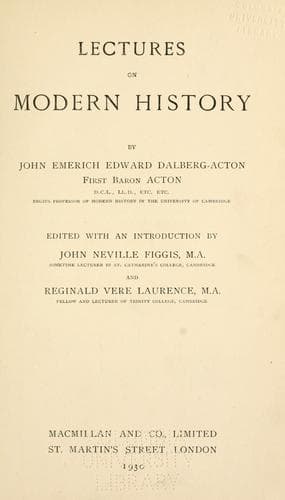
Lectures on Modern historyActon, John Emerich Edward Dalberg Acton, Baron
History
Lectures on Modern history
Acton, John Emerich Edward Dalberg Acton, Baron
History, Modern
The Federal Constitution did not deal with the question of religious
liberty. The rules for the election of the president and for that of
the vice-president proved a failure. Slavery was deplored, was
denounced, and was retained. The absence of a definition of State
Rights led to the most sanguinary civil war of modern times. Weighed
in the scales of Liberalism the instrument, as it stood, was a
monstrous fraud. And yet, by the development of the principle of
Federalism, it has produced a community more powerful, more
prosperous, more intelligent, and more free than any other which the
world has seen.
APPENDIX
APPENDIX I
THE following letter was sent out to the contributors to the Cambridge
History. It will interest many, as giving characteristic expression
to Acton's ideals as a historian.
The paragraphs are left as in the original.
[From the Editor of the Cambridge Modern History.]
1. Our purpose is to obtain the best history of modern times
that the published or unpublished sources of information admit.
The production of material has so far exceeded the use of it in
literature that very much more is known to students than can be
found in historians, and no compilation at second hand from
the best works would meet the scientific demand for completeness
and certainty.
In our own time, within the last few years, most of the official
collections in Europe have been made public, and nearly all the
evidence that will ever appear is accessible now.
As archives are meant to be explored, and are not meant to be
printed, we approach the final stage in the conditions of
historical learning.
The long conspiracy against the knowledge of truth has been
practically abandoned, and competing scholars all over the
civilised world are taking advantage of the change.
By dividing our matter among more than one hundred writers we
hope to make the enlarged opportunities of research avail for
the main range of modern history.
Froude spoke of 100,000 papers consulted by him in manuscript,
abroad and at home; and that is still the price to be paid for
mastery, beyond the narrow area of effective occupation.
We will endeavour to procure transcripts of any specified
documents which contributors require from places out of reach.
2. It is intended that the narrative shall be such as will serve
all readers, that it shall be without notes, and without quotations
in foreign languages.
In order to authenticate the text and to assist further research,
it is proposed that a selected list of original and auxiliary
authorities shall be supplied in each volume, for every chapter
or group of chapters dealing with one subject.
Such a bibliography of modern history might be of the utmost
utility to students, and would serve as a substitute for the
excluded references.
Public-domain text, read in full here on John Shaqi.
Reviews
Reviews
No reviews yet
Be the first to share your thoughts on this work.
Elsewhere in the archive
Join the Discussion
Join the discussion
Sign in to leave a comment or review.
Sign InorCreate an account