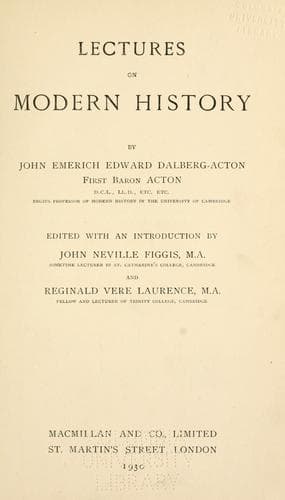
Lectures on Modern historyActon, John Emerich Edward Dalberg Acton, Baron
History
Lectures on Modern history
Acton, John Emerich Edward Dalberg Acton, Baron
History, Modern
In this epoch of full-grown history men have not acquiesced in
the given conditions of their lives. Taking little for granted
they have sought to know the ground they stand on, and the road
they travel, and the reason why. Over them, therefore, the
historian has obtained an increasing ascendancy #17. The law of
stability was overcome by the power of ideas, constantly varied
and rapidly renewed #18; ideas that give life and motion, that take
wing and traverse seas and frontiers, making it futile to pursue
the consecutive order of events in the seclusion of a separate
nationality #19. They compel us to share the existence of societies
wider than our own, to be familiar with distant and exotic types,
to hold our march upon the loftier summits, along the central
range, to live in the company of heroes, and saints, and men of
genius, that no single country could produce. We cannot afford
wantonly to lose sight of great men and memorable lives, and are
bound to store up objects for admiration as far as may be #20; for
the effect of implacable research is constantly to reduce their
number. No intellectual exercise, for instance, can be more
invigorating than to watch the working of the mind of Napoleon,
the most entirely known as well as the ablest of historic men.
In another sphere, it is the vision of a higher world to be
intimate with the character of Fenelon, the cherished model of
politicians, ecclesiastics, and men of letters, the witness
against one century and precursor of another, the advocate of the
poor against oppression, of liberty in an age of arbitrary power,
of tolerance in an age of persecution, of the humane virtues
among men accustomed to sacrifice them to authority, the man of
whom one enemy says that his cleverness was enough to strike
terror, and another, that genius poured in torrents from his
eyes. For the minds that are greatest and best alone furnish the
instructive examples. A man of ordinary proportion or inferior
metal knows not how to think out the rounded circle of his
thought, how to divest his will of its surroundings and to rise
above the pressure of time and race and circumstance #21, to choose
the star that guides his course, to correct, and test, and assay
his convictions by the light within #22, and, with a resolute
conscience and ideal courage, to remodel and reconstitute the
character which birth and education gave him #23.
Public-domain text, read in full here on John Shaqi.
Reviews
Reviews
No reviews yet
Be the first to share your thoughts on this work.
Join the Discussion
Join the discussion
Sign in to leave a comment or review.
Sign InorCreate an account