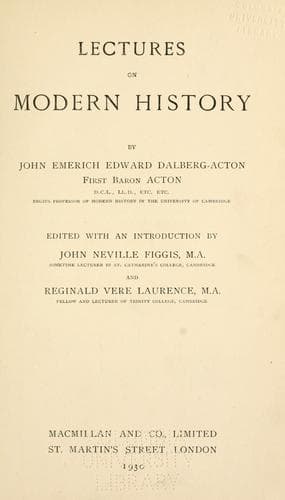
Lectures on Modern historyActon, John Emerich Edward Dalberg Acton, Baron
History
Lectures on Modern history
Acton, John Emerich Edward Dalberg Acton, Baron
History, Modern
In the midst of foreign armies, and of new combinations disturbing the
established balance of Italian Powers, the lesser potentates were
exposed to destruction; and there were forces about sufficient, under
capable guidance, to remodel the chaotic centre of Italy, where no
strong government had ever been constituted. Caesar Borgia recognised
the opportunity as soon as the French were at Milan; the Pope was
growing old and was clay in his terrible hands. His sister just then
became Duchess of Ferrara, on the border of the defenceless region
which he coveted; and the dominions of the King of France, his patron
and ally, extended to the Adda and the Po. Never had such advantages
been united in such a man. For Caesar's talents were of the imperial
kind. He was fearless of difficulties, of dangers, and of
consequences; and having no preference for right or wrong, he weighed
with an equal and dispassionate mind whether it was better to spare a
man or to cut his throat. As he did not attempt more than he could
perform, his rapid success awakened aspirations for a possible future.
He was odious to Venice, but a Venetian, who watched his meteoric
course, wonders, in his secret diary, whether this unerring schemer
was to be the appointed deliverer. He was a terror to Florence, yet
the Florentine secretary, to whom he confided his thoughts in certain
critical hours, wrote of him as men have written of Napoleon, and
erected a monument to his memory that has secretly fascinated half the
politicians in the world.
With his double equipment as a lieutenant of the French king and as a
condottiere of the Pope, he began by reviving the dormant authority of
Rome, where nominal feudatories held vicarious sway. In the place of
many despots struggling not for objects of policy, but for their own
existence, there appeared a single state, reaching from sea to sea,
from the Campagna to the salt-marshes by the delta of the Po, under a
papal prince and gonfaloniere, invested with rights and prerogatives
to protect the Holy See, and with power to control it. Rome would
have become a dependency of the reigning house of Borgia, as it had
been of less capable vassals, and the system might have lasted as long
as the brain that devised it. Lorenzo de' Medici once said that his
buildings were the only works that would outlast him; and it is common
in the secular characters of that epoch, unlike the priesthood, not to
believe in those things that are abiding, and not to regard
organisations that are humble and obscure at first and bloom by slow
degrees for the use of another age.
Public-domain text, read in full here on John Shaqi.
Reviews
Reviews
No reviews yet
Be the first to share your thoughts on this work.
Elsewhere in the archive
Join the Discussion
Join the discussion
Sign in to leave a comment or review.
Sign InorCreate an account