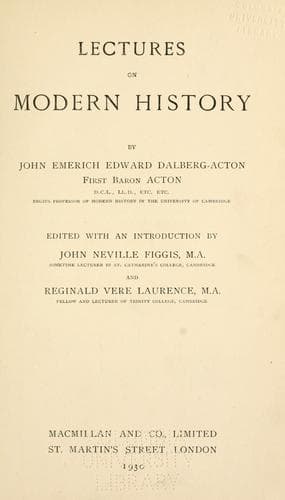
Lectures on Modern historyActon, John Emerich Edward Dalberg Acton, Baron
History
Lectures on Modern history
Acton, John Emerich Edward Dalberg Acton, Baron
History, Modern
Caesar's enterprise was not determined or limited by the claims of the
Vatican. He served both Pope and king, and his French alliance
carried farther than the recovery of the Romagna. Florence became
tributary by taking him into pay. Bologna bought him off with a heavy
ransom. Venice inscribed his name in the illustrious record of its
nobility. None could tell where his ambition or his resources would
end, how his inventive genius would employ the rivalry of the
invaders, what uses he would devise for the Emperor and the Turk. The
era of petty tyranny was closed by the apparition of one superior
national tyrant, who could be no worse than twenty, for though his
crimes would be as theirs, they would not be useless to the nation,
but were thoughtfully designed and executed for the sake of power, the
accepted object of politics in a country where the right was known by
the result. Caesar was not an unpopular master, and his subjects were
true to him in his falling fortunes. The death of Alexander and the
decline of the French cause in the South cut short his work in the
autumn of 1503. Della Rovere, Cardinal Vincula, whose title came from
the Church of St. Peter in Chains, the inflexible enemy of the
Borgias, was now Julius II; and after a brief interval he was strong
enough to drive Caesar out of the country; while the Venetians,
entering the Romagna under ill omens for the Republic, occupied the
remnant of his many conquests.
Julius had resisted Alexander, as a man unfit for his function, and it
soon appeared that this was not a private feud, but a total reversal
of ideas and policy. The change was not felt in religious reform or
in patronage of learning, but first in the notion of territorial
politics. Caesar had rebuilt the duchy of Romagna in the service of
the papacy; and it was the essence of the schemes of Julius that it
should be secured for the Holy See, together with all else that could
be claimed by right, or acquired by policy and war. The Borgias had
prevailed by arms, and Julius would not consent to be their inferior
and to condemn his whole career. He must draw the sword; but, unlike
them, he would draw it in the direct interest of the Church. He had
overthrown the conqueror, not that the conquests might be dissolved,
or might go to Venice, but in order that he himself and his successors
might have power in Italy, and through Italians, over the world. Upon
this foundation he instituted the temporal power, as it subsisted for
three centuries. The jealous municipal spirit of the Middle Ages had
dissolved society into units, and nothing but force could reverse the
tradition and weld the fragments into great communities. Borgia had
shown that this could be done; but also that no victorious
condottiere, were he even his own son, could be trusted by a Pope.
Julius undertook to command his army himself, and to fight at the head
of his troops. Letting his white beard grow, putting on armour, and
Public-domain text, read in full here on John Shaqi.
Reviews
Reviews
No reviews yet
Be the first to share your thoughts on this work.
Elsewhere in the archive
Join the Discussion
Join the discussion
Sign in to leave a comment or review.
Sign InorCreate an account