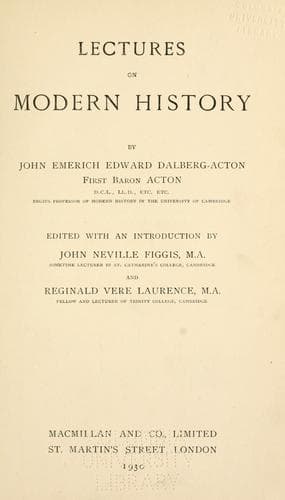
Lectures on Modern historyActon, John Emerich Edward Dalberg Acton, Baron
History
Lectures on Modern history
Acton, John Emerich Edward Dalberg Acton, Baron
History, Modern
Lewis XII swore that he would wreak vengeance on the papacy, and, in
conjunction with the Emperor, opened a Council at Pisa, which was
attended by a minority of cardinals. Julius met the attack by calling
a general Council to meet at the Lateran, which was the first since
the great reforming Council, and was still sitting when Julius died in
1513. Like the Council at Pisa, it was regarded at Rome as a move in
the great game of Politics, and it made no serious attempt to heal the
longstanding and acknowledged wounds of the Church. Its action spread
the belief that the reigning diseases were known, but that the remedy
was refused, and that reforms that might help religion were not to be
expected from Church or State. Julius II died without having expelled
the barbarians, as he had promised. The French were gone, but the
Spaniards remained unshaken, and were still the pivot of the
operations of the Holy See. The investiture of Naples was granted to
Ferdinand of Aragon, and the fairest region in Europe bound Spain
irrevocably to the Popes.
Although the Italian scheme of Julius was left half-way, his Roman
scheme was completed; the intermittent suzerainty of the Middle Ages
was straightened out into effective sovereignty over the half of
Central Italy, where anarchy used to reign, and the temporal power was
fixed on foundations solid enough to bear the coming diminution of
spiritual power. The added splendours of modern royalty, round which
cardinals of reigning houses--Medici, Este, Famese, Gonzaga--displayed
the pomp and ceremony of semi-regal state, in palaces built by
Bramante and Michael Angelo, with the ambassadors and protectors of
the Powers, and the heads of princely families that had worn the
tiara, made Rome the magnetic pole of aristocratic society. As the
capital of an absolute monarchy, as others were, it became associated
with principles which, in the Middle Ages, it resisted with spiritual
and secular weapons; and the magnitude of the change was apparent when
Leo X, by the Concordat of Bologna, conceded to Francis I the choice
of bishops and the higher patronage of the Church of France. For
Francis on his accession sent an army into Italy, the last work of
Julius II was overthrown at Marignano, and France again was master of
the Milanese.
Public-domain text, read in full here on John Shaqi.
Reviews
Reviews
No reviews yet
Be the first to share your thoughts on this work.
Elsewhere in the archive
Join the Discussion
Join the discussion
Sign in to leave a comment or review.
Sign InorCreate an account