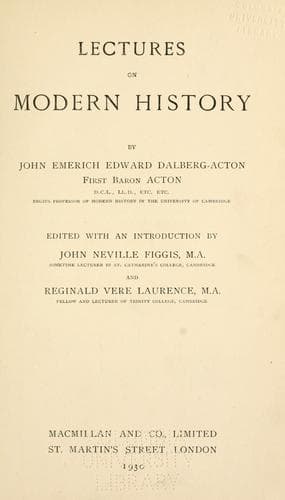
Lectures on Modern historyActon, John Emerich Edward Dalberg Acton, Baron
History
Lectures on Modern history
Acton, John Emerich Edward Dalberg Acton, Baron
History, Modern
The final struggle was to come at the vacancy of the Imperial throne.
Ferdinand of Aragon was dead, and Naples passed to the King of
undivided Spain. It was the unswerving policy of Rome that it should
not be united with the Empire, and against that fixed axiom the
strongest dynasty of emperors went to pieces. The Reformation had
just begun in Germany, and Leo wished one of the Northern Electors to
be chosen as Maximilian's successor. In conformity with the political
situation, he would have preferred Frederic of Saxony, the protector
of Luther. The election of Charles, in 1519, was a defiance of the
Balance of Power, a thing not to the taste of the Middle Ages, but
becoming familiar in those days. France, unable formerly to keep
Naples against Spain, had now to defend Lombardy against Spain,
supported by Germany, Naples, and the Netherlands. Francis maintained
the unequal struggle for four years, although his most powerful
vassal, Bourbon, brought the enemy to the gates of Marseilles. The
decisive action of the long Italian war was fought at Pavia in June
1525, where Francis was taken prisoner, and was compelled to purchase
his release by cruel sacrifices.
The years that followed are only a phase in the permanent subjugation
of Italy, but they are memorable in another connection. For the
triumph of Pavia brought the suppression of the Lutherans within the
range of practical politics. The Peasants' War had damaged their
position; the Emperor was able now to execute the Imperial decree of
Worms, and there were some in Germany who desired it. He made it a
condition of his prisoner's deliverance that he should assist in
destroying them; and Francis readily offered to do it by coming in
person, and bearing half the charge. Charles proposed to take him at
his word, when he learnt that the Pope was at the head of a great
alliance against him. Pope Clement was advised by the best
ecclesiastic in his court, the Datario Giberti, to try one more
struggle before the chains were riveted, and before he became, as they
said, a Spanish chaplain. It is a war, said Giberti, not for power or
dominion, but for the redemption of Italy from perpetual bondage; and
he placed his master, for the moment, at the head of the nation.
Clement concluded a treaty with the Emperor's enemies at Cognac,
released Francis from his oath to observe the Treaty of Madrid, and
endeavoured to make Pescara, the victor of Pavia, turn traitor by the
prospect of the throne of Naples.
Public-domain text, read in full here on John Shaqi.
Reviews
Reviews
No reviews yet
Be the first to share your thoughts on this work.
Elsewhere in the archive
Join the Discussion
Join the discussion
Sign in to leave a comment or review.
Sign InorCreate an account