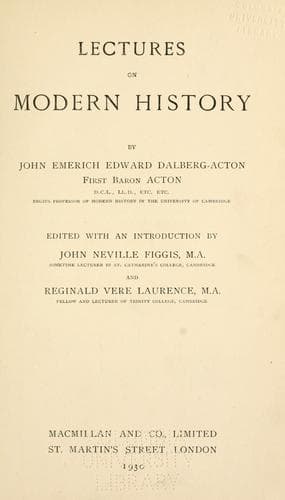
Lectures on Modern historyActon, John Emerich Edward Dalberg Acton, Baron
History
Lectures on Modern history
Acton, John Emerich Edward Dalberg Acton, Baron
History, Modern
This law of the modern world, that power tends to expand indefinitely,
and will transcend all barriers, abroad and at home, until met by
superior forces, produces the rhythmic movement of History. Neither
race, nor religion, nor political theory has been in the same degree
an incentive to the perpetuation of universal enmity and national
strife. The threatened interests were compelled to unite for the
self-government of nations, the toleration of religions, and the
rights of men. And it is by the combined efforts of the weak, made
under compulsion, to resist the reign of force and constant wrong,
that, in the rapid change but slow progress of four hundred years,
liberty has been preserved, and secured, and extended, and finally
understood.
II
THE NEW WORLD
GREATER CHANGES than those which were wrought by governments or armies
on the battlefield of Italy were accomplished at the same time,
thousands of miles away, by solitary adventurers, with the future of
the world in their hands. The Portuguese were the first Europeans to
understand that the ocean is not a limit, but the universal waterway
that unites mankind. Shut in by Spain, they could not extend on land,
and had no opening but the Atlantic. Their arid soil gave little scope
to the territorial magnate, who was excluded from politics by the
growing absolutism of the dynasty, and the government found it well to
employ at a distance forces that might be turbulent at home.
The great national work of exploration did not proceed from the
State. The Infante Henry had served in the African wars, and his
thoughts were drawn towards distant lands. He was not a navigator
himself; but from his home at Sagres, on the Sacred Promontory, he
watched the ships that passed between the great maritime centre at the
mouth of the Tagus and the regions that were to compose the Portuguese
empire. As Grandmaster of the Order of Christ he had the means to
equip them, and he rapidly occupied the groups of islands that lie
between Africa and mid Atlantic, and that were a welcome accession to
the narrow territory of Portugal. Then he sent his mariners to explore
the coast of the unknown and dreaded continent. When they reached the
Senegal and the Gambia, still more, when the coast of Guinea trended
to the East, they remembered Prester John, and dreamed of finding a
way to his fictitious realm which would afford convenient leverage for
Christendom, at the back of the dark world that faced the
Mediterranean.
Public-domain text, read in full here on John Shaqi.
Reviews
Reviews
No reviews yet
Be the first to share your thoughts on this work.
Elsewhere in the archive
Join the Discussion
Join the discussion
Sign in to leave a comment or review.
Sign InorCreate an account