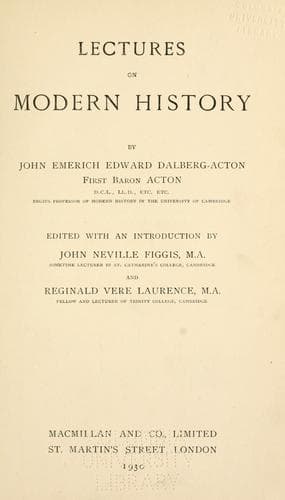
Lectures on Modern historyActon, John Emerich Edward Dalberg Acton, Baron
History
Lectures on Modern history
Acton, John Emerich Edward Dalberg Acton, Baron
History, Modern
This was the consummation of the Italian wars, by which the main
conditions of modern politics were determined. The conflicts which
had lasted for a generation, and the disorder and violence which were
older still, were at an end; Italy obtained repose from her master,
and spent for centuries her intellect in his service. Pescara,
Ferrante, Gonzaga, Philibert Emanuel, Spinola, were the men who made
Spain the first of military powers. And Parma's invincible legions,
which created Belgium, wrested Antwerp from the Dutch, delivered Paris
from Henry IV, and watched the signals of the Armada that they might
subdue England, were thronged with Italian infantry. Excepting
Venice, strong in her navy and her unapproachable lagoon, Spain
dominated thenceforward over Italy, and became, by her ascendency in
both Sicilies, a bulwark against the Turks.
Italy passed out of general politics, and was a force in Europe only
through Rome. The Conclave, and the creation of cardinals to compose
the Conclave, made it a constant school of negotiation and intrigue
for the best diplomacy in the world. By favour of the Habsburgs, the
papacy obtained a fixed dominion, secure against all comers, requiring
no military defence, no wasting and profitless expenditure, nothing to
dissolve the mirage of an ideal government, under spiritual and
converted men. The pontificates became steadily longer, averaging six
years in the sixteenth century, eight in the seventeenth, twelve in
the eighteenth, sixteen in the nineteenth, and by the original and
characteristic institution which is technically known as nepotism, the
selection of a Prime Minister, not from the College of the
ecclesiastical aristocracy, but from the family of the reigning
sovereign, the tonsured statesmen introduced a dynastic infusion into
the fluctuations of elective monarchy.
The triumph and coronation of the Emperor Charles V, when he was
superior to all that Europe had beheld since Charlemagne, revived the
ancient belief in a supreme authority elevated on alliance with the
priesthood, at the expense of the independence and the equipoise of
nations. The exploits of Magellan and Cortez, upsetting all habits of
perspective, called up vain dreams of the coming immensity of Spain,
and roused the phantom of universal empire. The motive of domination
became a reigning force in Europe; for it was an idea which monarchy
would not willingly let fall after it had received a religious and an
international consecration. For centuries it was constantly asserted
as a claim of necessity and of right. It was the supreme
manifestation of the modern state according to the image which
Machiavelli had set up, the state that suffers neither limit nor
equality, and is bound by no duty to nations or to men, that thrives
on destruction, and sanctifies whatever things contributed to increase
of power.
Public-domain text, read in full here on John Shaqi.
Reviews
Reviews
No reviews yet
Be the first to share your thoughts on this work.
Elsewhere in the archive
Join the Discussion
Join the discussion
Sign in to leave a comment or review.
Sign InorCreate an account