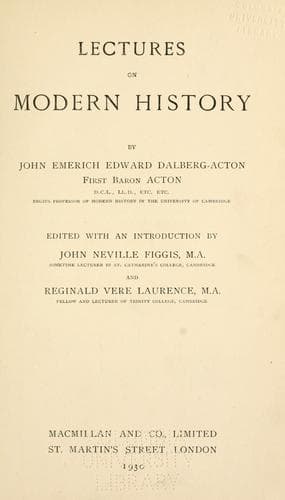
Lectures on Modern historyActon, John Emerich Edward Dalberg Acton, Baron
History
Lectures on Modern history
Acton, John Emerich Edward Dalberg Acton, Baron
History, Modern
The secret of Portuguese prosperity was the small bulk and the
enormous market value of the particular products in which they dealt.
In those days men had to do without tea, or coffee, or chocolate, or
tobacco, or quinine, or coca, or vanilla, and sugar was very rare.
But there were the pepper and the ginger of Malabar, cardamoms in the
damp district of Tellicherry; cinnamon and pearls in Ceylon. Beyond
the Bay of Bengal, near the equator, there was opium, the only
conqueror of pain then known; there were frankincense and indigo;
camphor in Borneo; nutmeg and mace in Amboyna; and in two small
islands, only a few miles square, Ternate and Tidor, there was the
clove tree, surpassing all plants in value. These were the real spice
islands, the enchanted region which was the object of such passionate
desire; and their produce was so cheap on the spot, so dear in the
markets of Antwerp and London, as to constitute the most lucrative
trade in the world. From these exotics, grown on volcanic soil, in
the most generous of the tropical climates, the profit was such that
they could be paid for in precious metals. When Drake was at Ternate
in 1579, he found the Sultan hung with chains of bullion, and clad in
a robe of gold brocade rich enough to stand upright. The Moluccas
were of greater benefit to the Crown than to the Portuguese workman.
About twenty ships, of 100 to 550 tons, sailed for Lisbon in the year.
A voyage sometimes lasted two years out and home, and cost, including
the ship, over L4000. But the freight might amount to L150,000.
Between 1497 and 1612 the number of vessels engaged in the India trade
was 806. Of these, ninety-six were lost. After the annexation by
Philip II, Lisbon was closed to countries at war with Spain. Dutch
and English had to make their own bargains in the East, and treated
Portugal as an enemy. Their empire declined rapidly, and the Dutch
acquired the islands long before the English succeeded on the mainland
of India.
Public-domain text, read in full here on John Shaqi.
Reviews
Reviews
No reviews yet
Be the first to share your thoughts on this work.
Elsewhere in the archive
Join the Discussion
Join the discussion
Sign in to leave a comment or review.
Sign InorCreate an account