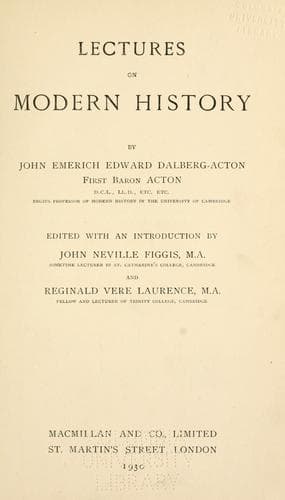
Lectures on Modern historyActon, John Emerich Edward Dalberg Acton, Baron
History
Lectures on Modern history
Acton, John Emerich Edward Dalberg Acton, Baron
History, Modern
The Portuguese acknowledged no obligations of international law
towards Asiatics. Even now, many people know of no law of nations but
that which consists in contracts and conventions; and with the people
of the East there were none. They were regarded as outlaws and
outcasts, nearly as Bacon regarded the Spaniards and Edmund Burke the
Turks. Solemn instruments had declared it lawful to expropriate and
enslave Saracens and other enemies of Christ. What was right in
Africa could not be wrong in Asia. Cabral had orders to treat with
fire and sword any town that refused to admit either missionary or
merchant. Barros, the classic historian of Portuguese Asia, says that
Christians have no duties towards pagans; and their best writers
affirm to this day that such calculated barbarities as they inflicted
on women and children were justified by the necessity of striking
terror. In the Commentaries of the great Albuquerque, his son relates
with complacency how his father caused the Zamorin to be poisoned.
These theories demoralised the entire government. S. Francis Xavier,
who came out in 1542, found an organised system of dishonesty and
plunder, and wrote home that no official in India could save his soul.
By him and his brethren many converts were made, and as intermarriages
were frequent, the estrangement grew less between the races. Just
then, the Inquisition was introduced into Portugal, and sent a branch
to Goa. One of the governors afterwards reported that it had helped
to alienate the natives, whose temples were closed. But the solid
structure of Almeida and Albuquerque was strong enough to defeat a
second expedition from Egypt, after Egypt had become a province of
Turkey, and an Indian war and insurrection. It declined with the
decline of Portugal under Sebastian, in the latter part of the
sixteenth century, but it perished through its association with Spain,
at the hands of enemies not its own, and not from internal causes.
While the Asiatic empire was built up by the sustained and patient
effort of a nation, during seventy years, the discovery of the West
was due to one eager and original intellect, propelled by medieval
dreams. Columbus had sailed both North and South; but the idea which
changed the axis of the globe came to him from books. He failed to
draw an inference favourable to his design from the driftwood which a
tropical current carries to Iceland, and proceeded on the assurance of
Pierre d'Ailly and of Toscanelli, that Asia reaches so far east as to
leave but a moderate interval between Portugal and Japan. Although he
rested his case on arguments from the classics and the prophets, his
main authority was Toscanelli; but it is uncertain whether, as he
affirmed, they had been in direct correspondence, or whether Columbus
obtained the letter and the Chart of 1474 by means which were the
cause of his disgrace.
Public-domain text, read in full here on John Shaqi.
Reviews
Reviews
No reviews yet
Be the first to share your thoughts on this work.
Elsewhere in the archive
Join the Discussion
Join the discussion
Sign in to leave a comment or review.
Sign InorCreate an account