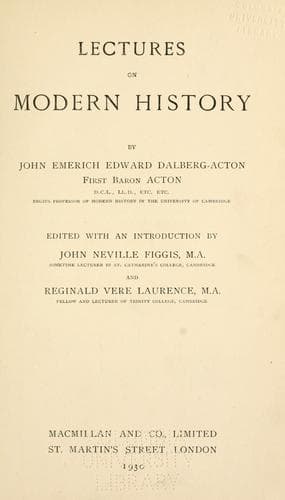
Lectures on Modern historyActon, John Emerich Edward Dalberg Acton, Baron
History
Lectures on Modern history
Acton, John Emerich Edward Dalberg Acton, Baron
History, Modern
Rejected by Portugal, he made his way into Spain. He was found,
starving, at the gate of a Franciscan convent; and the place where he
sank down is marked by a monument, because it is there that our modern
world began. The friar who took him in and listened to his story soon
perceived that this ragged mendicant was the most extraordinary person
he had known, and he found him patrons at the court of Castile. The
argument which Columbus now laid before the learned men of Spain was
this: The eastern route, even if the Portuguese succeed in finding it,
would be of no use to them, as the voyage to Cipango, to Cathay, even
to the spice islands, would be too long for profit. It was better to
sail out into the West, for that route would be scarcely 3000 miles to
the extremity of Asia; the other would be 15,000, apart from the
tremendous circuit of Africa, the extent of which was ascertained by
Diaz while Columbus was pursuing his uphill struggle. The basis of
the entire calculation was that the circumference of the earth is
18,000 miles at the equator, and that Asia begins, as is shown in
Toscanelli's chart, somewhere about California. Misled by his belief
in cosmographers, he blotted out the Pacific, and estimated the extent
of water to be traversed at one-third of the reality. The Spaniards,
who were consulted, pointed out the flaw, for the true dimensions were
known; but they were unable to demonstrate the truths against the
great authorities cited on the other side. The sophisms of Columbus
were worth more than all the science of Salamanca. The objectors who
called him a visionary were in the right, and he was obstinately
wrong. To his auspicious persistency in error Americans owe, among
other things, their existence.
Public-domain text, read in full here on John Shaqi.
Reviews
Reviews
No reviews yet
Be the first to share your thoughts on this work.
Elsewhere in the archive
Join the Discussion
Join the discussion
Sign in to leave a comment or review.
Sign InorCreate an account