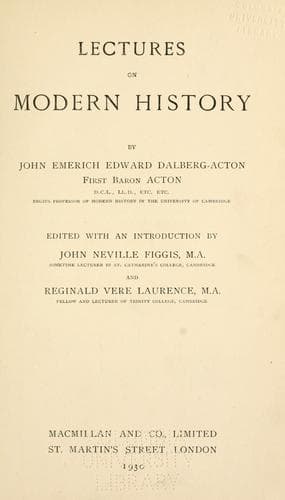
Lectures on Modern historyActon, John Emerich Edward Dalberg Acton, Baron
History
Lectures on Modern history
Acton, John Emerich Edward Dalberg Acton, Baron
History, Modern
All this was somewhat hypothetical and vague; but nothing could be
more definite than the reward which he demanded. For it appeared that
what this forlorn adventurer required for himself was to be admiral of
the Atlantic, ranking with the constable of Castile, Viceroy with
power of life and death, in the regions to be occupied, and a large
proportion of the intended spoil. And he would accept no less. None
divined what he himself knew not, that the thing he offered in return
was dominion over half the world. Therefore, when he found that this
would not do, Columbus saddled his mule and took the road to France.
In that superb moment he showed what man he was, and the action was
more convincing than his words had been. An Aragonese official,
Santangel, found the money, the L1500 required for the expedition, and
the traveller was overtaken by an alguazil a couple of leagues away,
and recalled to Granada. Santangel was, by descent, a Jew. Several
of his kindred suffered under the Inquisition, before and after, and
he fortified himself against the peril of the hour when he financed
the first voyage of Columbus. Granada fell on the 2nd of January
1492. The Jews were expelled on the 10th of March. On the 17th of
April the contract with Columbus was signed at Santa Fe. The same
crusading spirit, the same motive of militant propagandism, appears in
each of the three transactions. And the explorer, at this early
stage, was generally backed by the clergy. Juan Perez, the hospitable
Franciscan, was his friend; and Mendoza, the great cardinal of Toledo,
and Deza, afterwards Archbishop of Seville. Talavera, the Archbishop
of Granada, found him too fanciful to be trusted.
Sailing due west from the Canaries he crossed the Atlantic in its
widest part. The navigation was prosperous and uneventful until,
changing their course to follow the flight of birds, they missed the
continent and came upon the islands. It was the longest voyage that
had ever been attempted in the open sea; but the passage itself, and
the shoals and currents of the West Indies, were mastered with the aid
of nautical instruments from Nuremberg, and of the Ephemerides of
Regiomontanus. These were recent achievements of the Renaissance, and
without them the undertaking was impossible. Even with the new
appliances, Columbus was habitually wrong in his measurements. He put
Cuba 18 degrees too far to the west; he thought San Domingo as large
as Spain; and he saw mountains 50,000 feet high in Yucatan. Indeed,
he protested that his success was not due to science, but to the study
of the prophet Isaiah. Above all things, he insisted that Cuba was
part of the Asiatic continent, and obliged his companions to testify
to the same belief, although there is evidence that he did not share
it.
Public-domain text, read in full here on John Shaqi.
Reviews
Reviews
No reviews yet
Be the first to share your thoughts on this work.
Elsewhere in the archive
Join the Discussion
Join the discussion
Sign in to leave a comment or review.
Sign InorCreate an account