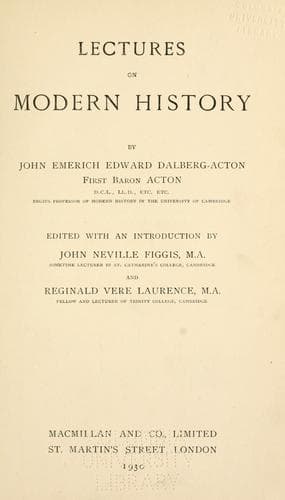
Lectures on Modern historyActon, John Emerich Edward Dalberg Acton, Baron
History
Lectures on Modern history
Acton, John Emerich Edward Dalberg Acton, Baron
History, Modern
He had promised Cathay. If he produced an unknown continent instead,
a continent many thousands of miles long, prohibiting approach to
Cathay, he would undo his own work; the peasants who had exposed his
fallacies would triumph in his failure, and the competing Portuguese
would appropriate all that he had undertaken to add to the crown of
Castile. Without civilisation and gold his discoveries would be
valueless; and there was so little gold at first that he at once
proposed to make up for it in slaves. His constant endeavour was not
to be mistaken for the man who discovered the new world. Somewhere in
the near background he still beheld the city with the hundred bridges,
the crowded bazaar, the long train of caparisoned elephants, the
palace with the pavement of solid gold. Naked savages skulking in the
forest, marked down by voracious cannibals along the causeway of the
Lesser Antilles, were no distraction from the quest of the Grand Khan.
The facts before him were uninteresting and provisional, and were
overshadowed by the phantoms that crowded his mind. The contrast
between the gorgeous and entrancing vision and the dismal and
desperate reality made the position a false one. He went on seeking
gold when it was needful to govern, and proved an incapable
administrator. Long before his final voyage he had fallen into
discredit, and he died in obscurity.
Many miserable years passed after his death before America began,
through Cortez, to weigh perceptibly in the scales of Europe. Landing
at Lisbon from his first expedition, Columbus, in all his glory, had
an audience of the king. It was six years since Diaz proved that the
sea route to India was perfectly open, but no European had since set
eyes on the place where Table Mountain looks down on the tormented
Cape. Portugal apparently had renounced the fruits of his discovery.
It was now reported that a Spanish crew had found in the West what the
Portuguese had been seeking in the East, and that the Papal privilege
had been infringed. The king informed Columbus that the regions he
had visited belonged to Portugal. It was evident that some limit must
be drawn separating the respective spheres. Rome had forbidden Spain
from interfering with the expeditions of Portugal, and the Spaniards
accordingly demanded a like protection. On the surface, there was no
real difficulty. Three Bulls were issued in 1493, two in May and one
in September, admonishing Portuguese mariners to keep to the east of a
line drawn about 35 degrees west of Greenwich. That line of demarcation
was suggested by Columbus, as corresponding with a point he had reached
on 13th September, 100 leagues beyond the Azores. On that day the
needle, which had pointed east of the Pole, shifted suddenly to the
west. There, he reckoned, was the line of No Variation. At that
moment, the climate changed. There was a smooth sea and a balmy air;
there was a new heaven and a new earth. The fantastic argument did
Public-domain text, read in full here on John Shaqi.
Reviews
Reviews
No reviews yet
Be the first to share your thoughts on this work.
Elsewhere in the archive
Join the Discussion
Join the discussion
Sign in to leave a comment or review.
Sign InorCreate an account