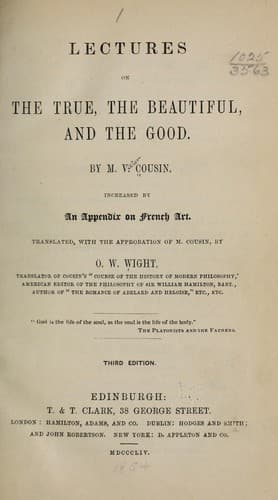
Lectures on the true, the beautiful and the goodCousin, Victor
Philosophy
Lectures on the true, the beautiful and the good
Cousin, Victor
Aesthetics; Ethics; Truth
In order to render the difference which we wish to mark more
perceptible, examples may be multiplied. Are you affected in the same
way at the sight of a meadow, variegated in its rather limited
dimensions, whose extent the eye can easily take in, and at the aspect
of an inaccessible mountain, at the foot of which the ocean breaks? Do
the sweet light of day and a melodious voice produce upon you the same
effect as darkness and silence? In the intellectual and moral order, are
you moved in the same way when a rich and good man opens his purse to
the indigent, and when a magnanimous man gives hospitality to his enemy,
and saves him at the peril of his own life? Take some light poetry in
which measure, spirit, and grace, everywhere predominate; take an ode,
and especially an epistle of Horace, or some small verses of Voltaire,
and compare them with the Iliad, or those immense Indian poems that are
filled with marvellous events, wherein the highest metaphysics are
united to recitals by turns graceful or pathetic, those poems that have
more than two hundred thousand verses, whose personages are gods or
symbolic beings; and see whether the impressions that you experience
will be the same. As a last example, suppose, on the one hand, a writer
who, with two or three strokes of the pen, sketches an analysis of
intelligence, agreeable and simple, but without depth, and, on the
other, a philosopher who engages in a long labor in order to arrive at
the most rigorous decomposition of the faculty of knowing, and unfolds
to you a long chain of principles and consequences,--read the _Traite
des Sensations_ and _the Critique of Pure Reason_, and, even leaving out
of the account the truth and the falsehood they may contain, with
reference solely to the beautiful, compare your impressions.
These are, then, two very different sentiments; different names have
also been given them: one has been more particularly called the
sentiment of the beautiful, the other that of the sublime.
In order to complete the study of the different faculties that enter
into the perception of beauty, after reason and sentiment, it remains to
us to speak of a faculty not less necessary, which animates them and
vivifies them,--imagination.
When sensation, judgment, and sentiment have been produced by the
occasion of an external object, they are reproduced even in the absence
of this object; this is memory.
Memory is double:--not only do I remember that I have been in the
presence of a certain object, but I represent to myself this absent
object as it was, as I have seen, felt, and judged it:--the remembrance
is then an image. In this last case, memory has been called by some
philosophers imaginative memory. Such is the foundation of imagination;
but imagination is something more still.
Public-domain text, read in full here on John Shaqi.
Reviews
Reviews
No reviews yet
Be the first to share your thoughts on this work.
Elsewhere in the archive
Join the Discussion
Join the discussion
Sign in to leave a comment or review.
Sign InorCreate an account