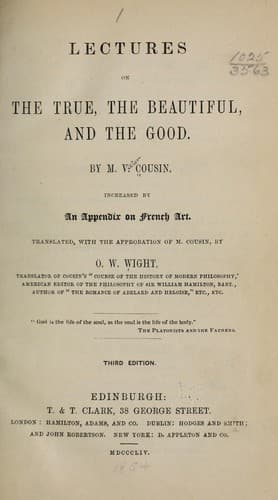
Lectures on the true, the beautiful and the goodCousin, Victor
Philosophy
Lectures on the true, the beautiful and the good
Cousin, Victor
Aesthetics; Ethics; Truth
The mind, applying itself to the images furnished by memory, decomposes
them, chooses between their different traits, and forms of them new
images. Without this new power, imagination would be captive in the
circle of memory.
The gift of being strongly affected by objects and reproducing their
absent or vanished images, and the power of modifying these images so as
to compose of them new ones,--do they fully constitute what men call
imagination? No, or at least, if these are indeed the proper elements of
imagination, there must be something else added, to wit, the sentiment
of the beautiful in all its degrees. By this means is a great
imagination preserved and kindled. Did the careful reading of Titus
Livius enable the author of the _Horaces_ to vividly represent to
himself some of the scenes described, to seize their principal traits
and combine them happily? From the outset, sentiment, love of the
beautiful, especially of the morally beautiful, were requisite; there
was required that great heart whence sprang the word of the ancient
Horace.
Let us be well understood. We do not say that sentiment is imagination,
we say that it is the source whence imagination derives its inspirations
and becomes productive. If men are so different in regard to
imagination, it is because some are cold in presence of objects, cold in
the representations which they preserve of them, cold also in the
combinations which they form of them, whilst others, endowed with a
particular sensibility, are vividly moved by the first impressions of
objects, preserve strong recollections of them, and carry into the
exercise of all their faculties this same force of emotion. Take away
sentiment and all else is inanimate; let it manifest itself, and every
thing receives warmth, color, and life.
It is then impossible to limit imagination, as the word seems to demand,
to images properly so called, and to ideas that are related to physical
objects. To remember sounds, to choose between them, to combine them in
order to draw from them new effects,--does not this belong to
imagination, although sound is not an image? The true musician does not
possess less imagination than the painter. Imagination is conceded to
the poet when he retraces the images of nature; will this same faculty
be refused him when he retraces sentiments? But, besides images and
sentiments, does not the poet employ the high thoughts of justice,
liberty, virtue, in a word, moral ideas? Will it be said that in moral
paintings, in pictures of the intimate life of the soul, either graceful
or energetic, there is no imagination?
Public-domain text, read in full here on John Shaqi.
Reviews
Reviews
No reviews yet
Be the first to share your thoughts on this work.
Elsewhere in the archive
Join the Discussion
Join the discussion
Sign in to leave a comment or review.
Sign InorCreate an account