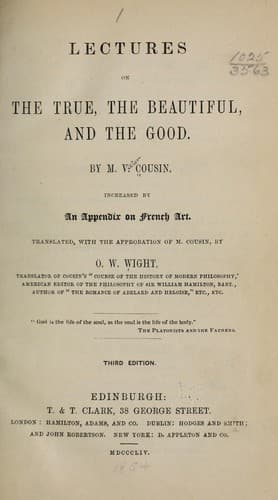
Lectures on the true, the beautiful and the goodCousin, Victor
Philosophy
Lectures on the true, the beautiful and the good
Cousin, Victor
Aesthetics; Ethics; Truth
Plotinus, in his treatise _On the Beautiful_,[105] proposed to himself
this question. He asks--What is the beautiful in itself? I see clearly
that such or such a form is beautiful, that such or such an action is
also beautiful; but why and how are these two objects, so dissimilar,
beautiful? What is the common quality which, being found in these two
objects, ranges them under the general idea of the beautiful?
It is necessary to answer this question, or the theory of beauty is a
maze without issue; one applies the same name to the most diverse
things, without understanding the real unity that authorizes this unity
of name.
Either the diversities which we have designated in beauty are such that
it is impossible to discover their relation, or these diversities are
especially apparent, and have their harmony, their concealed unity.
Is it pretended that this unity is a chimera? Then physical beauty,
moral beauty, and intellectual beauty, are strangers to each other.
What, then, will the artist do? He is surrounded by different beauties,
and he must make a work; for such is the recognized law of art. But if
this unity that is imposed upon him is a factitious unity, if there are
in nature only essentially dissimilar beauties, art deceives and lies to
us. Let it be explained, then, how falsehood is the law of art. That
cannot be; the unity that art expresses, it must have somewhere caught a
glimpse of, in order to transport it into its works.
We neither retract the distinction between the beautiful and the
sublime, nor the other distinctions just now indicated; but it is
necessary to re-unite after having distinguished them. These
distinctions and these re-unions are not contradictory: the great law of
beauty, like that of truth, is unity as well as variety. All is one, and
all is diverse. We have divided beauty into three great
classes--physical beauty, intellectual beauty, and moral beauty. We must
now seek the unity of these three sorts of beauty. Now, we think that
they resolve themselves into one and the same beauty, moral beauty,
meaning by that, with moral beauty properly so called, all spiritual
beauty.
Let us put this opinion to the proof of facts.
Public-domain text, read in full here on John Shaqi.
Reviews
Reviews
No reviews yet
Be the first to share your thoughts on this work.
Elsewhere in the archive
Join the Discussion
Join the discussion
Sign in to leave a comment or review.
Sign InorCreate an account