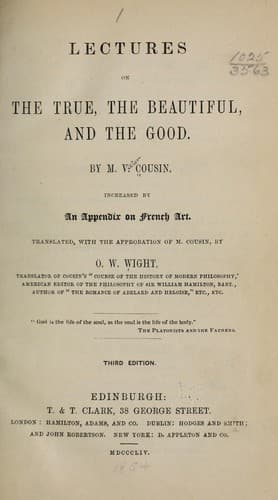
Lectures on the true, the beautiful and the goodCousin, Victor
Philosophy
Lectures on the true, the beautiful and the good
Cousin, Victor
Aesthetics; Ethics; Truth
The most probable theory of the beautiful is that which composes it of
two contrary and equally necessary elements, unity and variety. Behold a
beautiful flower. Without doubt, unity, order, proportion, symmetry
even, are in it; for, without these qualities, reason would be absent
from it, and all things are made with a marvellous reason. But, at the
same time, what a diversity! How many shades in the color, what richness
in the least details! Even in mathematics, what is beautiful is not an
abstract principle, it is a principle carrying with itself a long chain
of consequences. There is no beauty without life, and life is movement,
is diversity.
Unity and variety are applied to all orders of beauty. Let us rapidly
run over these different orders.
In the first place, there are beautiful objects, to speak properly, and
sublime objects. A beautiful object, we have seen, is something
completed, circumscribed, limited, which all our faculties easily
embrace, because the different parts are on a somewhat narrow scale. A
sublime object is that which, by forms not in themselves
disproportionate, but less definite and more difficult to seize, awakens
in us the sentiment of the infinite.
There are two very distinct species of beauty. But reality is
inexhaustible, and in all the degrees of reality there is beauty.
Among sensible objects, colors, sounds, figures, movements, are capable
of producing the idea and the sentiment of the beautiful. All these
beauties are arranged under that species of beauty which, right or
wrong, is called physical beauty.
If from the world of sense we elevate ourselves to that of mind, truth,
and science, we shall find there beauties more severe, but not less
real. The universal laws that govern bodies, those that govern
intelligences, the great principles that contain and produce long
deductions, the genius that creates, in the artist, poet, or
philosopher,--all these are beautiful, as well as nature herself: this
is what is called intellectual beauty.
Finally, if we consider the moral world and its laws, the idea of
liberty, virtue, and devotedness, here the austere justice of an
Aristides, there the heroism of a Leonidas, the prodigies of charity or
patriotism, we shall certainly find a third order of beauty that still
surpasses the other two, to wit, moral beauty.
Neither let us forget to apply to all these beauties the distinction
between the beautiful and the sublime. There are, then, the beautiful
and the sublime at once in nature, in ideas, in sentiments, in actions.
What an almost infinite variety in beauty!
After having enumerated all these differences, could we not reduce them?
They are incontestable; but, in this diversity is there not unity? Is
there not a single beauty of which all particular beauties are only
reflections, shades, degrees, or degradations?
Public-domain text, read in full here on John Shaqi.
Reviews
Reviews
No reviews yet
Be the first to share your thoughts on this work.
Elsewhere in the archive
Join the Discussion
Join the discussion
Sign in to leave a comment or review.
Sign InorCreate an account