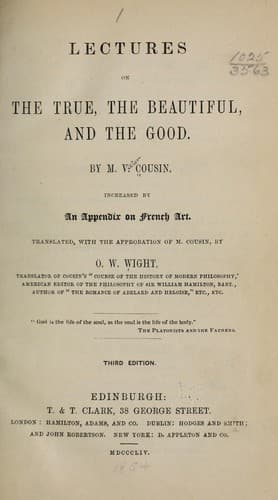
Lectures on the true, the beautiful and the goodCousin, Victor
Philosophy
Lectures on the true, the beautiful and the good
Cousin, Victor
Aesthetics; Ethics; Truth
Consider the figure of man in repose: it is more beautiful than that of
an animal, the figure of an animal is more beautiful than the form of
any inanimate object. It is because the human figure, even in the
absence of virtue and genius, always reflects an intelligent and moral
nature, it is because the figure of an animal reflects sentiment at
least, and something of soul, if not the soul entire. If from man and
the animal we descend to purely physical nature, we shall still find
beauty there, as long as we find there some shade of intelligence, I
know not what, that awakens in us some thought, some sentiment. Do we
arrive at some piece of matter that expresses nothing, that signifies
nothing, neither is the idea of beauty applied to it. But every thing
that exists is animated. Matter is shaped and penetrated by forces that
are not material, and it obeys laws that attest an intelligence
everywhere present. The most subtile chemical analysis does not reach a
dead and inert nature, but a nature that is organized in its own way,
that is neither deprived of forces nor laws. In the depths of the earth,
as in the heights of the heavens, in a grain of sand as in a gigantic
mountain, an immortal spirit shines through the thickest coverings. Let
us contemplate nature with the eye of the soul as well as with the eye
of the body:--everywhere a moral expression will strike us, and the
forms of things will impress us as symbols of thought. We have said
that with man, and with the animal even, the figure is beautiful on
account of the expression. But, when you are on the summit of the Alps,
or before the immense Ocean, when you behold the rising or setting of
the sun, at the beginning or the close of the day, do not these imposing
pictures produce on you a moral effect? Do all these grand spectacles
appear only for the sake of appearing? Do we not regard them as
manifestations of an admirable power, intelligence, and wisdom? And,
thus to speak, is not the face of nature expressive like that of man?
Form cannot be simply a form, it must be the form of something. Physical
beauty is, then, the sign of an internal beauty, which is spiritual and
moral beauty; and this is the foundation, the principle, the unity of
the beautiful.[109]
Public-domain text, read in full here on John Shaqi.
Reviews
Reviews
No reviews yet
Be the first to share your thoughts on this work.
Elsewhere in the archive
Join the Discussion
Join the discussion
Sign in to leave a comment or review.
Sign InorCreate an account