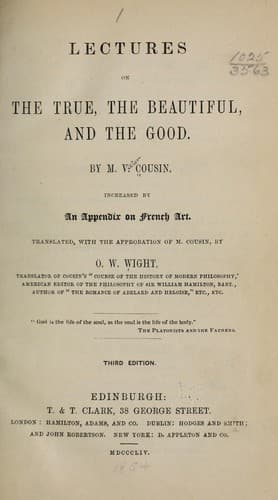
Lectures on the true, the beautiful and the goodCousin, Victor
Philosophy
Lectures on the true, the beautiful and the good
Cousin, Victor
Aesthetics; Ethics; Truth
All the beauties that we have just enumerated and reduced compose what
is called the really beautiful. But, above real beauty, is a beauty of
another order--ideal beauty. The ideal resides neither in an individual,
nor in a collection of individuals. Nature or experience furnishes us
the occasion of conceiving it, but it is essentially distinct. Let it
once be conceived, and all natural figures, though never so beautiful,
are only images of a superior beauty which they do not realize. Give me
a beautiful action, and I will imagine one still more beautiful. The
Apollo itself is open to criticism in more than one respect. The ideal
continually recedes as we approach it. Its last termination is in the
infinite, that is to say, in God; or, to speak more correctly, the true
and absolute ideal is nothing else than God himself.
God, being the principle of all things, must for this reason be that of
perfect beauty, and, consequently, of all natural beauties that express
it more or less imperfectly; he is the principle of beauty, both as
author of the physical world and as father of the intellectual and moral
world.
Is it not necessary to be a slave of the senses and of appearances in
order to stop at movements, at forms, at sounds, at colors, whose
harmonious combinations produce the beauty of this visible world, and
not to conceive behind this scene so magnificent and well regulated, the
orderer, the geometer, the supreme artist?
Physical beauty serves as an envelope to intellectual and moral beauty.
What can be the principle of intellectual beauty, that splendor of the
true, except the principle of all truth?
Moral beauty comprises, as we shall subsequently see,[110] two distinct
elements, equally but diversely beautiful, justice and charity, respect
and love of men. He who expresses in his conduct justice and charity,
accomplishes the most beautiful of all works; the good man is, in his
way, the greatest of all artists. But what shall we say of him who is
the very substance of justice and the exhaustless source of love? If our
moral nature is beautiful, what must be the beauty of its author! His
justice and goodness are everywhere, both in us and out of us. His
justice is the moral order that no human law makes, that all human laws
are forced to express, that is preserved and perpetuated in the world by
its own force. Let us descend into ourselves, and consciousness will
attest the divine justice in the peace and contentment that accompany
virtue, in the troubles and tortures that are the invariable punishments
of vice and crime. How many times, and with what eloquence, have men
celebrated the indefatigable solicitude of Providence, its benefits
everywhere manifest in the smallest as well as in the greatest phenomena
of nature, which we forget so easily because they have become so
familiar to us, but which, on reflection, call forth our mingled
admiration and gratitude, and proclaim a good God, full of love for his
creatures!
Public-domain text, read in full here on John Shaqi.
Reviews
Reviews
No reviews yet
Be the first to share your thoughts on this work.
Elsewhere in the archive
Join the Discussion
Join the discussion
Sign in to leave a comment or review.
Sign InorCreate an account