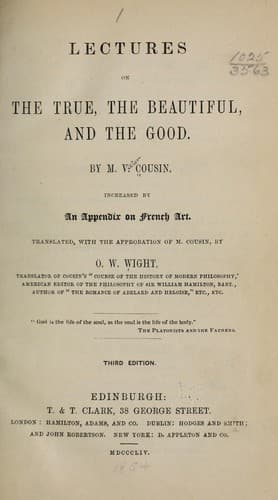
Lectures on the true, the beautiful and the goodCousin, Victor
Philosophy
Lectures on the true, the beautiful and the good
Cousin, Victor
Aesthetics; Ethics; Truth
"Eternal beauty, unbegotten and imperishable, exempt from decay as well
as increase, which is not beautiful in such a part and ugly in such
another, beautiful only, at such a time, in such a place, in such a
relation, beautiful for some, ugly for others, beauty that has no
sensible form, no visage, no hands, nothing corporeal, which is not such
a thought or such a particular science, which resides not in any being
different from itself, as an animal, the earth, or the heavens, or any
other thing, which is absolutely identical and invariable by itself, in
which all other beauties participate, in such a way, nevertheless, that
their birth or their destruction neither diminishes nor increases, nor
in the least changes it!... In order to arrive at this perfect beauty,
it is necessary to commence with the beauties of this lower world, and,
the eyes being fixed upon the supreme beauty, to elevate ourselves
unceasingly towards it, by passing, thus to speak, through all the
degrees of the scale, from a single beautiful body to two, from two to
all others, from beautiful bodies to beautiful sentiments, from
beautiful sentiments to beautiful thoughts, until from thought to
thought we arrive at the highest thought, which has no other object than
the beautiful itself, until we end by knowing it as it is in itself.
"O my dear Socrates," continued the stranger of Mantinea, "that which
can give value to this life is the spectacle of the eternal beauty....
What would be the destiny of a mortal to whom it should be granted to
contemplate the beautiful without alloy, in its purity and simplicity,
no longer clothed with the flesh and hues of humanity, and with all
those vain charms that are condemned to perish, to whom it should be
given to see face to face, under its sole form, the divine beauty!"[111]
FOOTNOTES:
[103] If one would make himself acquainted with a simple and piquant
refutation, written two thousand years ago, of false theories of beauty,
he may read the _Hippias_ of Plato, vol. iv. of our translation. The
_Phaedrus_, vol. vi., contains the veiled exposition of Plato's own
theory; but it is in the _Banquet_ (_Ibid._), and particularly in the
discourse of Diotimus, that we must look for the thought of Plato
carried to its highest degree of development, and clothed with all the
beauty of human language.
[104] See the _Hippias_.
[105] First _Ennead_, book vi., in the work of M. B. Saint-Hillaire, on
the _School of Alexandria_, the translation of this morsel of Plotinus,
p. 197.
Public-domain text, read in full here on John Shaqi.
Reviews
Reviews
No reviews yet
Be the first to share your thoughts on this work.
Elsewhere in the archive
Join the Discussion
Join the discussion
Sign in to leave a comment or review.
Sign InorCreate an account