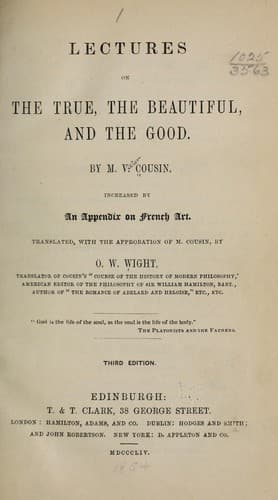
Lectures on the true, the beautiful and the goodCousin, Victor
Philosophy
Lectures on the true, the beautiful and the good
Cousin, Victor
Aesthetics; Ethics; Truth
Thus, God is the principle of the three orders of beauty that we have
distinguished, physical beauty, intellectual beauty, moral beauty.
In him also are reunited the two great forms of the beautiful
distributed in each of these three orders, to wit, the beautiful and the
sublime. God is, _par excellence_, the beautiful--for what object
satisfies more all our faculties, our reason, our imagination, our
heart! He offers to reason the highest idea, beyond which it has nothing
more to seek; to imagination the most ravishing contemplation; to the
heart a sovereign object of love. He is, then, perfectly beautiful; but
is he not sublime also in other ways? If he extends the horizon of
thought, it is to confound it in the abyss of his greatness. If the soul
blooms at the spectacle of his goodness, has it not also reason to be
affrighted at the idea of his justice, which is not less present to it?
God is at once mild and terrible. At the same time that he is the life,
the light, the movement, the ineffable grace of visible and finite
nature, he is also called the Eternal, the Invisible, the Infinite, the
Absolute Unity, and the Being of beings. Do not these awful attributes,
as certain as the first, produce in the highest degree in the
imagination and the soul that melancholy emotion excited by the sublime?
Yes, God is for us the type and source of the two great forms of beauty,
because he is to us at once an impenetrable enigma and still the
clearest word that we are able to find for all enigmas. Limited beings
as we are, we comprehend nothing in comparison with that which is
without limits, and we are able to explain nothing without that same
thing which is without limits. By the being that we possess, we have
some idea of the infinite being of God; by the nothingness that is in
us, we lose ourselves in the being of God; and thus always forced to
recur to him in order to explain any thing, and always thrown back
within ourselves under the weight of his infinitude, we experience by
turns, or rather at the same time, for this God who raises and casts us
down, a sentiment of irresistible attraction and astonishment, not to
say insurmountable terror, which he alone can cause and allay, because
he alone is the unity of the sublime and the beautiful.
Thus absolute being, which is both absolute unity and infinite
variety,--God, is necessarily the last reason, the ultimate foundation,
the completed ideal of all beauty. This is the marvellous beauty that
Diotimus had caught a glimpse of, and thus paints to Socrates in the
_Banquet_:
Public-domain text, read in full here on John Shaqi.
Reviews
Reviews
No reviews yet
Be the first to share your thoughts on this work.
Elsewhere in the archive
Join the Discussion
Join the discussion
Sign in to leave a comment or review.
Sign InorCreate an account