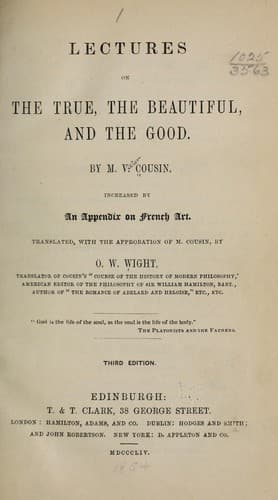
Lectures on the true, the beautiful and the goodCousin, Victor
Philosophy
Lectures on the true, the beautiful and the good
Cousin, Victor
Aesthetics; Ethics; Truth
These three faculties are certainly necessary for genius, but they are
not sufficient for it. What essentially distinguishes genius from taste
is the attribute of creative power. Taste feels, judges, discusses,
analyzes, but does not invent. Genius is, before all, inventive and
creative. The man of genius is not the master of the power that is in
him; it is by the ardent, irresistible need of expressing what he feels,
that he is a man of genius. He suffers by withholding the sentiments, or
images, or thoughts, that agitate his breast. It has been said that
there is no superior man without some grain of folly; but this folly,
like that of the cross, is the divine part of reason. This mysterious
power Socrates called his demon. Voltaire called it the devil in the
body; he demanded it even in a comedian in order to be a comedian of
genius. Give to it what name you please, it is certain that there is a
I-know-not-what that inspires genius, that also torments it until it has
delivered itself of what consumes it; until, by expressing them, it has
solaced its pains and its joys, its emotions, its ideas; until its
reveries have become living works. Thus two things characterize genius;
at first, the vivacity of the need it has of producing, then the power
of producing; for the need without the power is only a malady that
resembles genius, but is not it. Genius is above all, is essentially,
the power of doing, of inventing, of creating. Taste is contented with
observing, with admiring. False genius, ardent and impotent imagination,
consumes itself in sterile dreams and produces nothing, at least nothing
great. Genius alone has the power to convert conceptions into creations.
If genius creates it does not imitate.
But genius, it is said, is then superior to nature, since it does not
imitate it. Nature is the work of God; man is then the rival of God.
The answer is very simple. No, genius is not the rival of God; but it is
the interpreter of him. Nature expresses him in its way, human genius
expresses him in its own way.
Let us stop a moment at that question so much discussed,--whether art is
any thing else than the imitation of nature.
Doubtless, in one sense, art is an imitation; for absolute creation
belongs only to God. Where can genius find the elements upon which it
works, except in nature, of which it forms a part? But does it limit
itself to the reproduction of them as nature furnishes them to it,
without adding any thing to them which belongs to itself? Is it only a
copier of reality? Its sole merit, then, is that of the fidelity of the
copy. And what labor is more sterile than that of copying works
essentially inimitable on account of the life with which they are
endowed, in order to obtain an indifferent image of them? If art is a
servile pupil, it is condemned never to be any thing but an impotent
pupil.
Public-domain text, read in full here on John Shaqi.
Reviews
Reviews
No reviews yet
Be the first to share your thoughts on this work.
Elsewhere in the archive
Join the Discussion
Join the discussion
Sign in to leave a comment or review.
Sign InorCreate an account