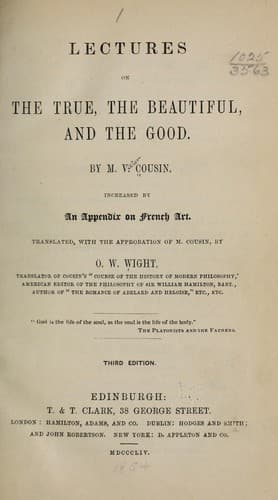
Lectures on the true, the beautiful and the goodCousin, Victor
Philosophy
Lectures on the true, the beautiful and the good
Cousin, Victor
Aesthetics; Ethics; Truth
The true artist feels and profoundly admires nature; but every thing in
nature is not equally admirable. As we have just said, it has something
by which it infinitely surpasses art--its life. Besides that, art can,
in its turn, surpass nature, on the condition of not wishing to imitate
it too closely. Every natural object, however beautiful, is defective on
some side. Every thing that is real is imperfect. Here, the horrible and
the hideous are united to the sublime; there, elegance and grace are
separated from grandeur and force. The traits of beauty are scattered
and diverse. To reunite them arbitrarily, to borrow from such a face a
mouth, eyes from such another, without any rule that governs this choice
and directs these borrowings, is to compose monsters; to admit a rule,
is already to admit an ideal different from all individuals. It is this
ideal that the true artist forms to himself in studying nature. Without
nature, he never would have conceived this ideal; but with this ideal,
he judges nature herself, rectifies her, and dares undertake to measure
himself with her.
The ideal is the artist's object of passionate contemplation.
Assiduously and silently meditated, unceasingly purified by reflection
and vivified by sentiment, it warms genius and inspires it with the
irresistible need of seeing it realized and living. For this end, genius
takes in nature all the materials that can serve it, and applying to
them its powerful hand, as Michael Angelo impressed his chisel upon the
docile marble, makes of them works that have no model in nature, that
imitate nothing else than the ideal dreamed of or conceived, that are in
some sort a second creation inferior to the first in individuality and
life, but much superior to it, we do not fear to say, on account of the
intellectual and moral beauty with which it is impressed.
Moral beauty is the foundation of all true beauty. This foundation is
somewhat covered and veiled in nature. Art disengages it, and gives to
it forms more transparent. On this account, art, when it knows well its
power and its resources, institutes with nature a contest in which it
may have the advantage.
Let us establish well the end of art: it is precisely where its power
lies. The end of art is the expression of moral beauty, by the aid of
physical beauty. The latter is only a symbol of the former. In nature,
this symbol is often obscure: art in bringing it to light attains
effects that nature does not always produce. Nature may please more,
for, once more, it possesses in an incomparable degree what makes the
great charm of imagination and sight--life; art touches more, because in
expressing, above all, moral beauty, it addresses itself more directly
to the source of profound emotions. Art can be more pathetic than
nature, and the pathetic is the sign and measure of great beauty.
Public-domain text, read in full here on John Shaqi.
Reviews
Reviews
No reviews yet
Be the first to share your thoughts on this work.
Elsewhere in the archive
Join the Discussion
Join the discussion
Sign in to leave a comment or review.
Sign InorCreate an account