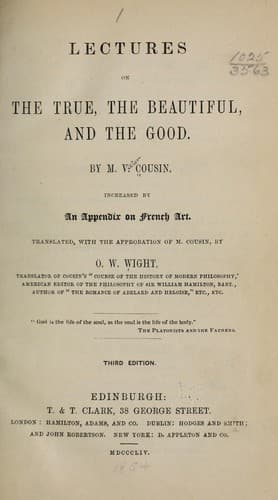
Lectures on the true, the beautiful and the goodCousin, Victor
Philosophy
Lectures on the true, the beautiful and the good
Cousin, Victor
Aesthetics; Ethics; Truth
So, to express the ideal of the infinite in one way or another, is the
law of art; and all the arts are such only by their relation to the
sentiment of the beautiful and the infinite which they awaken in the
soul, by the aid of that high quality of every work of art that is
called expression.
Expression is essentially ideal: what expression tries to make felt, is
not what the eye can see and the hand touch, evidently it is something
invisible and impalpable.
The problem of art is to reach the soul through the body. Art offers to
the senses forms, colors, sounds, words, so arranged that they excite in
the soul, concealed behind the senses, the inexpressible emotion of
beauty.
Expression is addressed to the soul as form is addressed to the senses.
Form is the obstacle of expression, and, at the same time, is its
imperative, necessary, only means. By working upon form, by bending it
to its service, by dint of care, patience, and genius, art succeeds in
converting an obstacle into a means.
By their object, all arts are equal; all are arts only because they
express the invisible. It cannot be too often repeated, that expression
is the supreme law of art. The thing to express is always the same,--it
is the idea, the spirit, the soul, the invisible, the infinite. But, as
the question is concerning the expression of this one and the same
thing, by addressing ourselves to the senses which are diverse, the
difference of the senses divides art into different arts.
We have seen, that, of the five senses which have been given to
man,[120] three--taste, smell, and touch--are incapable of producing in
us the sentiment of beauty. Joined to the other two, they may contribute
to the understanding of this sentiment; but alone and by themselves they
cannot produce it. Taste judges of the agreeable, not of the beautiful.
No sense is less allied to the soul and more in the service of the body;
it flatters, it serves the grossest of all masters, the stomach. If
smell sometimes seems to participate in the sentiment of the beautiful,
it is because the odor is exhaled from an object that is already
beautiful, that is beautiful for some other reason. Thus the rose is
beautiful for its graceful form, for the varied splendor of its colors;
its odor is agreeable, it is not beautiful. Finally, it is not touch
alone that judges of the regularity of forms, but touch enlightened by
sight.
Public-domain text, read in full here on John Shaqi.
Reviews
Reviews
No reviews yet
Be the first to share your thoughts on this work.
Elsewhere in the archive
Join the Discussion
Join the discussion
Sign in to leave a comment or review.
Sign InorCreate an account