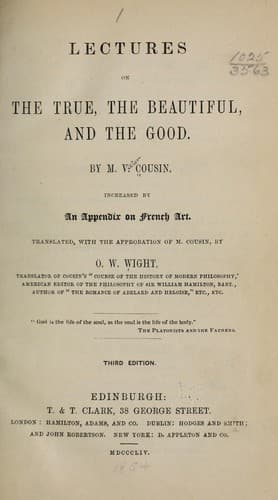
Lectures on the true, the beautiful and the goodCousin, Victor
Philosophy
Lectures on the true, the beautiful and the good
Cousin, Victor
Aesthetics; Ethics; Truth
route of the sublime and the beautiful, as well as by that of the true
and the good. The emotion that the beautiful produces turns the soul
from this world; it is the beneficent emotion that art produces for
humanity.
FOOTNOTES:
[112] _Recherches sur l'Art Statuaire._ Paris, 1805.
[113] Paris, 1815, in folio, an eminent work that will subsist even when
time shall have destroyed some of its details.
[114] Since reprinted under the title of _Essais sur l'Ideal dans ses
Applications Pratiques_. Paris, 1837.
[115] Translation of Plato, vol. xii., _Timaeus_, p. 116.
[116] _Orator:_ "Neque enim ille artifex (Phidias) cum faceret Jovis
formam aut Minervae, contemplabatur aliquem a quo similitudinem duceret;
sed ipsius in mente insidebat species pulchritudinis eximia quaedam, quam
intuens, in eaque defixus, ad illius similitudinem artem et manum
dirigebat."
[117] _Raccolta di lett._ _Sulla pitt._, i., p. 83. "_Essendo carestia e
de' buoni giudici e di belle donne, io mi servo di certa idea che mi
viene alla mente._"
[118] "A picture representing a broken glass over several subjects
painted on the canvas, by which the eye is deceived."
[119] Vassari, _Vie de Raphael_.
LECTURE IX.
THE DIFFERENT ARTS.
Expression is the general law of art.--Division of
arts.--Distinction between liberal arts and trades.--Eloquence
itself, philosophy, and history do not make a part of the fine
arts.--That the arts gain nothing by encroaching upon each
other, and usurping each other's means and
processes.--Classification of the arts:--its true principle is
expression.--Comparison of arts with each other.--Poetry the
first of arts.
A _resume_ of the last lecture would be a definition of art, of its end
and law. Art is the free reproduction of the beautiful, not of a single
natural beauty, but of ideal beauty, as the human imagination conceives
it by the aid of data which nature furnishes it. The ideal beauty
envelops the infinite:--the end of art is, then, to produce works that,
like those of nature, or even in a still higher degree, may have the
charm of the infinite. But how and by what illusion can we draw the
infinite from the finite? This is the difficulty of art, and its glory
also. What bears us towards the infinite in natural beauty? The ideal
side of this beauty. The ideal is the mysterious ladder that enables the
soul to ascend from the finite to the infinite. The artist, then, must
devote himself to the representation of the ideal. Every thing has its
ideal. The first care of the artist will be, then, whatever he does, to
penetrate at first to the concealed ideal of his subject, for his
subject has an ideal,--in order to render it, in the next place, more or
less striking to the senses and the soul, according to the conditions
which the very materials that he employs--the stone, the color, the
sound, the language--impose on him.
Public-domain text, read in full here on John Shaqi.
Reviews
Reviews
No reviews yet
Be the first to share your thoughts on this work.
Elsewhere in the archive
Join the Discussion
Join the discussion
Sign in to leave a comment or review.
Sign InorCreate an account