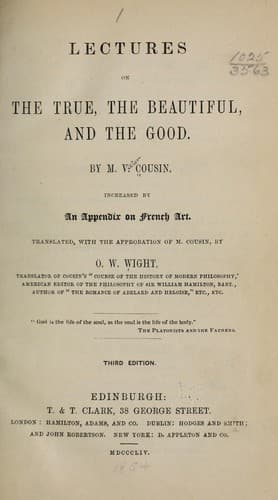
Lectures on the true, the beautiful and the goodCousin, Victor
Philosophy
Lectures on the true, the beautiful and the good
Cousin, Victor
Aesthetics; Ethics; Truth
Eloquence does not propose to itself to produce in the soul of the
auditors the disinterested sentiment of beauty. It may also produce this
effect, but without having sought it. Its direct end, which it can
subordinate to no other, is to convince, to persuade. Eloquence has a
client which before all it must save or make triumph. It matters little,
whether this client be a man, a people, or an idea. Fortunate is the
orator if he elicits the expression: That is beautiful! for it is a
noble homage rendered to his talent; unfortunate is he if he does not
elicit this, for he has missed his end. The two great types of political
and religious eloquence, Demosthenes in antiquity, Bossuet among the
moderns, think only of the interest of the cause confided to their
genius, the sacred cause of country and that of religion; whilst at
bottom Phidias and Raphael work to make beautiful things. Let us hasten
to say, what the names of Demosthenes and Bossuet command us to say,
that true eloquence, very different from that of rhetoric, disdains
certain means of success; it asks no more than to please, but without
any sacrifice unworthy of it; every foreign ornament degrades it. Its
proper character is simplicity, earnestness--I do not mean affected
earnestness, a designed and artful gravity, the worst of all
deceptions--I mean true earnestness, that springs from sincere and
profound conviction. This is what Socrates understood by true
eloquence.[121]
As much must be said of history and philosophy. The philosopher speaks
and writes. Can he, then, like the orator, find accents which make truth
enter the soul, colors and forms that make it shine forth evident and
manifest to the eyes of intelligence? It would be betraying his cause to
neglect the means that can serve it; but the profoundest art is here
only a means, the aim of philosophy is elsewhere; whence it follows that
philosophy is not an art. Without doubt, Plato is a great artist; he is
the peer of Sophocles and Phidias, as Pascal is sometimes the rival of
Demosthenes and Bossuet;[122] but both would have blushed if they had
discovered at the bottom of their soul another design, another aim than
the service of truth and virtue.
Public-domain text, read in full here on John Shaqi.
Reviews
Reviews
No reviews yet
Be the first to share your thoughts on this work.
Elsewhere in the archive
Join the Discussion
Join the discussion
Sign in to leave a comment or review.
Sign InorCreate an account