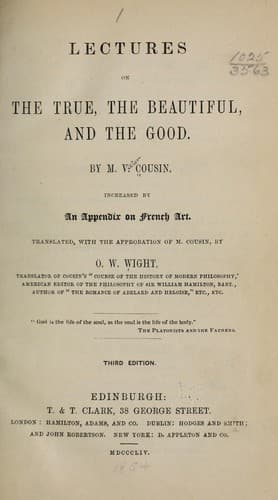
Lectures on the true, the beautiful and the goodCousin, Victor
Philosophy
Lectures on the true, the beautiful and the good
Cousin, Victor
Aesthetics; Ethics; Truth
History does not relate for the sake of relating; it does not paint for
the sake of painting; it relates and paints the past that it may be the
living lesson of the future. It proposes to instruct new generations by
the experience of those who have gone before them, by exhibiting to them
a faithful picture of great and important events, with their causes and
their effects, with general designs and particular passions, with the
faults, virtues, and crimes that are found mingled together in human
things. It teaches the excellence of prudence, courage, and great
thoughts profoundly meditated, constantly pursued, and executed with
moderation and force. It shows the vanity of immoderate pretensions, the
power of wisdom and virtue, the impotence of folly and crime.
Thucydides, Polybius, and Tacitus undertake any thing else than
procuring new emotions for an idle curiosity or a worn-out imagination;
they doubtless desire to interest and attract, but more to instruct;
they are the avowed masters of statesmen and the preceptors of mankind.
The sole object of art is the beautiful. Art abandons itself as soon as
it shuns this. It is often constrained to make concessions to
circumstances, to external conditions that are imposed upon it; but it
must always retain a just liberty. Architecture and the art of gardening
are the least free of arts; they are subjected to unavoidable obstacles;
it belongs to the genius of the artist to govern these obstacles, and
even to draw from them happy effects, as the poet turns the slavery of
metre and rhyme into a source of unexpected beauties. Extreme liberty
may carry art to a caprice which degrades it, as chains too heavy crush
it. It is the death of architecture to subject it to convenience, to
_comfort_. Is the architect obliged to subordinate general effect and
the proportions of the edifice to such or such a particular end that is
prescribed to him? He takes refuge in details, in pediments, in friezes,
in all the parts that have not utility for a special object, and in them
he becomes a true artist. Sculpture and painting, especially music and
poetry, are freer than architecture and the art of gardening. One can
also shackle them, but they disengage themselves more easily.
Public-domain text, read in full here on John Shaqi.
Reviews
Reviews
No reviews yet
Be the first to share your thoughts on this work.
Elsewhere in the archive
Join the Discussion
Join the discussion
Sign in to leave a comment or review.
Sign InorCreate an account