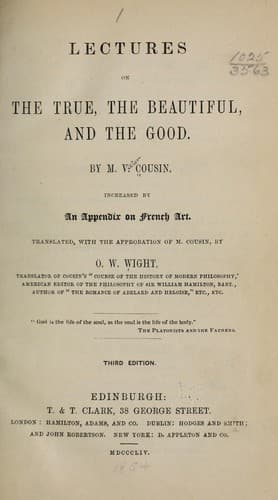
Lectures on the true, the beautiful and the goodCousin, Victor
Philosophy
Lectures on the true, the beautiful and the good
Cousin, Victor
Aesthetics; Ethics; Truth
Think of it. What a world of images, of sentiments, of thoughts at once
distinct and confused, are excited within us by this one word--country!
and by this other word, brief and immense,--God! What is more clear and
altogether more profound and vast!
Tell the architect, the sculptor, the painter, even the musician, to
call forth also by a single stroke all the powers of nature and the
soul! They cannot, and by that they acknowledge the superiority of
speech and poetry.
They proclaim it themselves, for they take poetry for their own measure;
they esteem their own works, and demand that they should be esteemed, in
proportion as they approach the poetic ideal. And the human race does as
artists do: a beautiful picture, a noble melody, a living and expressive
statue, gives rise to the exclamation--How poetical! This is not an
arbitrary comparison; it is a natural judgment which makes poetry the
type of the perfection of all the arts,--the art _par excellence_,
which comprises all others, to which they aspire, which none can reach.
When the other arts would imitate the works of poetry, they usually err,
losing their own genius, without robbing poetry of its genius. But
poetry constructs according to its own taste palaces and temples, like
architecture; it makes them simple or magnificent; all orders, as well
as all systems, obey it; the different ages of art are the same to it;
it reproduces, if it pleases, the classic or the Gothic, the beautiful
or the sublime, the measured or the infinite. Lessing has been able,
with the exactest justice, to compare Homer to the most perfect
sculptor; with such precision are the forms which that marvellous chisel
gives to all beings determined! And what a painter, too, is Homer! and,
of a different kind, Dante! Music alone has something more penetrating
than poetry, but it is vague, limited, and fugitive. Besides its
clearness, its variety, its durability, poetry has also the most
pathetic accents. Call to mind the words that Priam utters at the feet
of Achilles while asking him for the dead body of his son, more than one
verse of Virgil, entire scenes of the _Cid_ and the _Polyeucte_, the
prayer of Esther kneeling before the Lord, the choruses of _Esther_ and
_Athalie_. In the celebrated song of Pergolese, _Stabat Mater Dolorosa_,
we may ask which moves most, the music or the words. The _Dies irae, Dies
illa_, recited only, produces the most terrible effect. In those fearful
words, every blow tells, so to speak; each word contains a distinct
sentiment, an idea at once profound and determinate. The intellect
advances at each step, and the heart rushes on in its turn. Human speech
idealized by poetry has the depth and brilliancy of musical notes; it is
luminous as well as pathetic; it speaks to the mind as well as to the
heart; it is in that inimitable, unique, and embraces all extremes and
all contraries in a harmony that redoubles their reciprocal effect, in
Public-domain text, read in full here on John Shaqi.
Reviews
Reviews
No reviews yet
Be the first to share your thoughts on this work.
Elsewhere in the archive
Join the Discussion
Join the discussion
Sign in to leave a comment or review.
Sign InorCreate an account