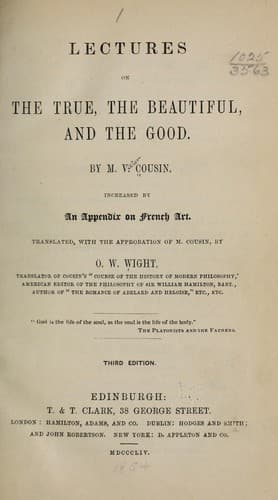
Lectures on the true, the beautiful and the goodCousin, Victor
Philosophy
Lectures on the true, the beautiful and the good
Cousin, Victor
Aesthetics; Ethics; Truth
excels in transporting to the feet of eternal mercy the soul trembling
on the wings of repentance, hope, and love. Happy are those, who, at
Rome, in the Vatican,[127] during the solemnities of the Catholic
worship, have heard the melodies of Leo, Durante, and Pergolese, on the
old consecrated text! They have entered heaven for a moment, and their
souls have been able to ascend thither without distinction of rank,
country, even belief, by those invisible and mysterious steps, composed,
thus to speak, of all the simple, natural, universal sentiments, that
everywhere on earth draw from the bosom of the human creature a sigh
towards another world!
Between sculpture and music, those two opposite extremes, is painting,
nearly as precise as the one, nearly as touching as the other. Like
sculpture, it marks the visible forms of objects, but adds to them life;
like music, it expresses the profoundest sentiments of the soul, and
expresses them all. Tell me what sentiment does not come within the
province of the painter? He has entire nature at his disposal, the
physical world, and the moral world, a churchyard, a landscape, a
sunset, the ocean, the great scenes of civil and religious life, all the
beings of creation, above all, the figure of man, and its expression,
that living mirror of what passes in the soul. More pathetic than
sculpture, clearer than music, painting is elevated, in my opinion,
above both, because it expresses beauty more under all its forms, and
the human soul in all the richness and variety of its sentiments.
But the art _par excellence_, that which surpasses all others, because
it is incomparably the most expressive, is poetry.
Speech is the instrument of poetry; poetry fashions it to its use, and
idealizes it, in order to make it express ideal beauty. Poetry gives to
it the charm and power of measure; it makes of it something intermediary
between the ordinary voice and music, something at once material and
immaterial, finite, clear, and precise, like contours and forms the most
definite, living and animated like color, pathetic and infinite like
sound. A word in itself, especially a word chosen and transfigured by
poetry, is the most energetic and universal symbol. Armed with this
talisman, poetry reflects all the images of the sensible world, like
sculpture and painting; it reflects sentiment like painting and music,
with all its varieties, which music does not attain, and in their rapid
succession that painting cannot follow, as precise and immobile as
sculpture; and it not only expresses all that, it expresses what is
inaccessible to every other art, I mean thought, entirely distinct from
the senses and even from sentiment,--thought that has no forms,--thought
that has no color, that lets no sound escape, that does not manifest
itself in any way,--thought in its highest flight, in its most refined
abstraction.
Public-domain text, read in full here on John Shaqi.
Reviews
Reviews
No reviews yet
Be the first to share your thoughts on this work.
Elsewhere in the archive
Join the Discussion
Join the discussion
Sign in to leave a comment or review.
Sign InorCreate an account