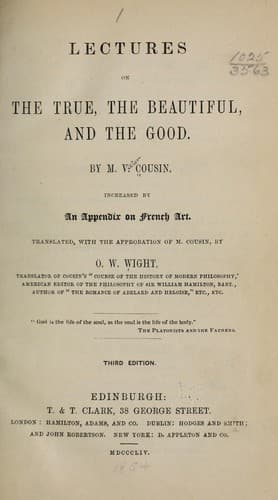
Lectures on the true, the beautiful and the goodCousin, Victor
Philosophy
Lectures on the true, the beautiful and the good
Cousin, Victor
Aesthetics; Ethics; Truth
We have cited this beautiful passage--and we could have cited many
others, even superior to it--of a man now forgotten, and almost always
misunderstood, but whom posterity will put in his place. Let us
indicate, at least, the last pages of the same production, on the
necessity of leaving the works of art in the place for which they were
made, for example, the portrait of Mlle. de Valliere in the _Madeleine
aux Carmelites_, instead of transferring it to, and exposing it in the
apartments of Versailles, "the only place in the world," eloquently says
M. Quatremere, "which never should have seen it."
LECTURE X.
FRENCH ART IN THE SEVENTEENTH CENTURY.
Expression not only serves to appreciate the different arts, but
the different schools of art. Example:--French art in the
seventeenth century. French poetry:--Corneille. Racine. Moliere.
La Fontaine. Boileau.--Painting:--Lesueur. Poussin. Le Lorrain.
Champagne.--Engraving.--Sculpture:--Sarrazin. The Anguiers.
Girardon. Pujet.--Le Notre.--Architecture.
We believe that we have firmly established that all kinds of beauty,
although most dissimilar in appearance, may, when subjected to a serious
examination, be reduced to spiritual and moral beauty; that expression,
therefore, is at once the true object and the first law of art; that all
arts are such only so far as they express the idea concealed under the
form, and are addressed to the soul through the senses; finally, that in
expression the different arts find the true measure of their relative
value, and the most expressive art must be placed in the first rank.
If expression judges the different arts, does it not naturally follow,
that by the same title it can also judge the different schools which, in
each art, dispute with each other the empire of taste?
There is not one of these schools that does not represent in its own way
some side of the beautiful, and we are disposed to embrace all in an
impartial and kindly study. We are eclectics in the arts as well as in
metaphysics. But, as in metaphysics, the knowledge of all systems, and
the portion of truth that is in each, enlightens without enfeebling our
convictions; so, in the history of arts, while holding the opinion that
no school must be disdained, that even in China some shade of beauty can
be found, our eclecticism does not make us waver in regard to the
sentiment of true beauty and the supreme rule of art. What we demand of
the different schools, without distinction of time or place, what we see
in the south as well as in the north, at Florence, Rome, Venice, and
Seville, as well as at Antwerp, Amsterdam, and Paris,--wherever there
are men, is something human, is the expression of a sentiment or an
idea.
Public-domain text, read in full here on John Shaqi.
Reviews
Reviews
No reviews yet
Be the first to share your thoughts on this work.
Elsewhere in the archive
Join the Discussion
Join the discussion
Sign in to leave a comment or review.
Sign InorCreate an account