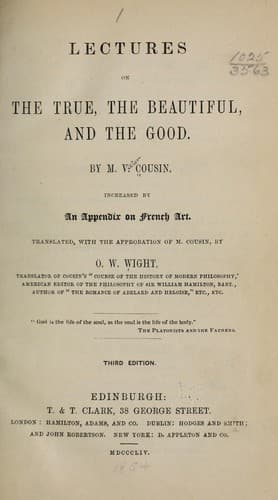
Lectures on the true, the beautiful and the goodCousin, Victor
Philosophy
Lectures on the true, the beautiful and the good
Cousin, Victor
Aesthetics; Ethics; Truth
A criticism that should be founded on the principle of expression, would
somewhat derange, it must be confessed, received judgments, and would
carry some disorder into the hierarchy of the renowned. We do not
undertake such a revolution; we only propose to confirm, or at least
elucidate our principle by an example, and by an example that is at our
hand.
There is in the world a school formerly illustrious, now very lightly
treated:--this school is the French school of the seventeenth century.
We would replace it in honor, by recalling attention to the qualities
that make its glory.
We have worked with constancy to reinstate among us the philosophy of
Descartes, unworthily sacrificed to the philosophy of Locke, because
with its defects it possesses in our view the incomparable merit of
subordinating the senses to the mind, of elevating and ennobling man. So
we profess a serious and reflective admiration for our national art of
the seventeenth century, because, without disguising what is wanting to
it, we find in it what we prefer to every thing else, grandeur united to
good sense and reason, simplicity and force, genius of composition,
especially that of expression.
France, careless of her glory, does not appear to have the least notion
that she reckons in her annals perhaps the greatest century of humanity,
that which embraces the greatest number of extraordinary men of every
kind. When, I pray you, have politicians like Henry IV., Richelieu,
Mazarin, Colbert, Louis XIV. been seen giving each other the hand? I do
not pretend that each of them has no rival, even superiors. Alexander,
Caesar, Charlemagne, perhaps excel them. But Alexander has but a single
contemporary that can be compared with him, his father Philip; Caesar
cannot even have suspected that Octavius would one day be worthy of
him; Charlemagne is a colossus in a desert; whilst among us these five
men succeed each other without an interval, press upon each other, and
have, thus to speak, a single soul. And by what officers were they
served! Is Conde really inferior to Alexander, Hannibal, and Caesar; for
among his predecessors we must not look for other rivals? Who among them
surpasses him in the extent and justness of his conceptions, in
quickness of sight, in rapidity of manoeuvres, in the union of
impetuosity and firmness, in the double glory of taker of cities and
gainer of battles? Add that he dealt with generals like Merci and
William, that he had under him Turenne and Luxemburg, without speaking
of so many other soldiers who were reared in that admirable school, and
at the hour of reverse still sufficed to save France.
Public-domain text, read in full here on John Shaqi.
Reviews
Reviews
No reviews yet
Be the first to share your thoughts on this work.
Elsewhere in the archive
Join the Discussion
Join the discussion
Sign in to leave a comment or review.
Sign InorCreate an account