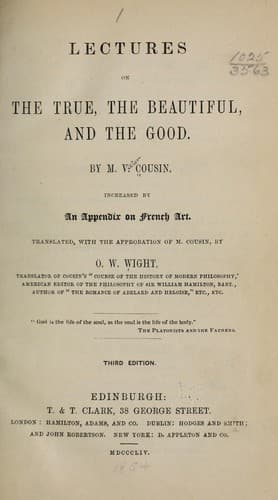
Lectures on the true, the beautiful and the goodCousin, Victor
Philosophy
Lectures on the true, the beautiful and the good
Cousin, Victor
Aesthetics; Ethics; Truth
Young artists, who, rightly disgusted with the dry and inanimate manner
of David, undertake to renovate French painting, who would rob the sun
of its heat and splendor, remember that of all beings in the world, the
greatest is still man, and that what is greatest in man is his
intelligence, and above all, his heart; that it is this heart, then,
which you must put and develop on your canvas. This is the most elevated
object of art. In order to reach it, do not make yourselves disciples of
Flemings, Venetians, and Spaniards; return, return to the masters of our
great national school of the seventeenth century.
We bow with respectful admiration before the schools of Rome and
Florence, at once ideal and living; but, those excepted, we maintain
that the French school equals or surpasses all others. We prefer neither
Murillo, Rubens, Corregio, nor Titian himself to Lesueur and Poussin,
because, if the former have an incomparable hand and color, our two
countrymen are much greater in thought and expression.
What a destiny was that of Eustache Lesueur![135] He was born at Paris
about 1617, and he never went out of it. Poor and humble, he passed his
life in the churches and convents where he worked. The only sweetness of
his sad days, his only consolation was his wife: he loses her, and goes
to die, at thirty-eight, in that cloister of Chartreux, which his pencil
has immortalized. What resemblance at once, and what difference between
his life and that of Raphael, who also died young, but in the midst of
pleasures, in honors, and already almost in purple! Our Raphael was not
the lover of Fornarina and the favorite of a pope: he was Christian; he
is Christianity in art.
Lesueur is a genius wholly French. Scarcely having escaped from the
hands of Simon Vouet, he formed himself according to the model which he
had in the soul. He never saw the sky of Italy. He knew some fragments
of the antique, some pictures of Raphael, and the designs that Poussin
sent him. With these feeble resources, and guided by a happy instinct,
in less than ten years he mounted by a continual progress to the
perfection of his talent, and expired at the moment when, finally sure
of himself, he was about to produce new and more admirable
master-pieces. Follow him from the _St. Bruno_ completed in 1648,
through the _St. Paul_ of 1649, to the _Vision of St. Benedict_ in 1651,
and to the _Muses_, scarcely finished before his death. Lesueur went on
adding to his essential qualities which he owed to his own genius, and
to the national genius, I mean composition and expression, qualities
which he had dreamed of, or had caught glimpses of. His design from day
to day became more pure, without ever being that of the Florentine
school, and the same is true of his coloring.
Public-domain text, read in full here on John Shaqi.
Reviews
Reviews
No reviews yet
Be the first to share your thoughts on this work.
Elsewhere in the archive
Join the Discussion
Join the discussion
Sign in to leave a comment or review.
Sign InorCreate an account