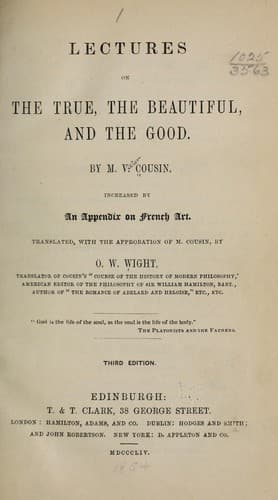
Lectures on the true, the beautiful and the goodCousin, Victor
Philosophy
Lectures on the true, the beautiful and the good
Cousin, Victor
Aesthetics; Ethics; Truth
By what strange diversity could a country, in which the mental arts
were carried to such perfection, remain ordinary in the other arts? Was
the sentiment of the beautiful wanting, then, to that society so
polished, to that magnificent court, to those great lords and those
great ladies passionately loving luxury and elegance, to that public of
the _elite_, enamored of every kind of glory, whose enthusiasm defended
the _Cid_ against Richelieu? No; France in the seventeenth century was a
whole, and produced artists that she can place by the side of her poets,
her philosophers, her orators.
But, in order to admire our artists, it is necessary to comprehend them.
We do not believe that imagination has been less freely imparted to
France than to any other nation of Europe. It has even had its reign
among us. It is fancy that rules in the sixteenth century, and inspires
the literature and the arts of the _Renaissance_. But a great revolution
intervened at the commencement of the seventeenth century. France at
that moment seems to pass from youth to virility. Instead of abandoning
imagination to itself, we apply ourselves from that moment to restrain
it without destroying it, to moderate it, as the Greeks did by the aid
of taste; as in the progress of life and society we learn to repress or
conceal what is too individual in character. An end is made of the
literature of the preceding age. A new poetry, a new prose, begin to
appear, which, during an entire century, bear fruits sufficiently
beautiful. Art follows the general movement; after having been elegant
and graceful, it becomes in its turn serious; it no longer aims at
originality and extraordinary effects; it neither flashes nor dazzles;
it speaks, above all, to the mind and the soul. Hence its good qualities
and also its defects. In general, it is somewhat wanting in brilliancy
and coloring, but it is in the highest degree expressive.
Some time since we have changed all that. We have discovered, somewhat
late, that we have not sufficient imagination; we are in training to
acquire it, it is true, at the expense of reason, alas! also at the
expense of soul, which is forgotten, repudiated, proscribed. At this
moment, color and form are the order of the day, in poetry, in painting,
in every thing. We are beginning to run mad with Spanish painting. The
Flemish and Venetian schools are gaining ground on the schools of
Florence and Rome. Rossini equals Mozart, and Gluck will soon seem to us
insipid.
Public-domain text, read in full here on John Shaqi.
Reviews
Reviews
No reviews yet
Be the first to share your thoughts on this work.
Elsewhere in the archive
Join the Discussion
Join the discussion
Sign in to leave a comment or review.
Sign InorCreate an account