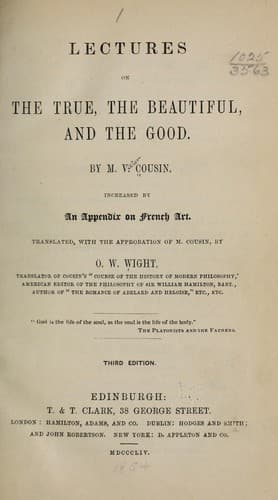
Lectures on the true, the beautiful and the goodCousin, Victor
Philosophy
Lectures on the true, the beautiful and the good
Cousin, Victor
Aesthetics; Ethics; Truth
Now, regard the _Muses_,--other scenes, other beauties, the same genius.
Those are Pagan pictures, but Christianity is in them also, by reason of
the adorable chastity with which Lesueur has clothed them. All critics
have emulously shown the mythological errors into which poor Lesueur
fell, and they have not wanted occasion to deplore that he had not made
the journey to Italy and studied antiquity more. But who can have the
strange idea of searching in Lesueur for an archeology? I seek and find
in him the very genius of painting. Is not that Terpsichore, well or ill
named, with a harp a little too strong, it is said, as if the Muse had
no particular gift, in her modest attitude the symbol of becoming grace?
In that group of three Muses, to which one may give what name he
pleases, is not the one that holds upon her knees a book of music, who
sings or is about to sing, the most ravishing creature, a St. Cecilia
that preludes just before abandoning herself to the intoxication of
inspiration? And in those pictures there is brilliancy and coloring; the
landscape is beautifully lighted, as if Poussin had guided the hand of
his friend.
Poussin! What a name I pronounce. If Lesueur is the painter of
sentiment, Poussin is the painter of thought. He is in some sort the
philosopher of painting. His pictures are religious or moral lectures
that testify a great mind as well as a great heart. It is sufficient to
recall the _Seven Sacraments_, the _Deluge_, the _Arcadia_, the _Truth
that Time frees from the Taints of Envy_, the _Will of Eudamidas_, and
the _Dance of Human Life_. And the style is equal to the conception.
Poussin draws like a Florentine, composes like a Frenchman, and often
equals Lesueur in expression; coloring alone is sometimes wanting to
him. As well as Racine, he is smitten with the antique beauty, and
imitates it; but, like Racine, he always remains original. In place of
the naivete and unique charm of Lesueur, he has a severe simplicity,
with a correctness that never abandons him. Remember, too, that he
cultivated every kind of painting. He is at once a great historical
painter and a great landscape painter,--he treats religious subjects as
well as profane subjects, and by turns is inspired by antiquity and the
Bible. He lived much at Rome, it is true, and died there; but he also
worked in France, and almost always for France. Scarcely had he become
known, when Richelieu attracted him to Paris and retained him there,
loading him with honors, and giving him the commission of first painter
in ordinary to the king, with the general direction of all the works of
painting, and all the ornaments of the royal houses. During that sojourn
of two years in Paris, he made the _Last Supper_ (_Cene_), the _St.
Francois Xavier_, the _Truth that Time frees from the Taints of Envy_.
It was also to France, to his friend M. de Chantelou, that from Rome he
addressed the _Inspiration of St. Paul_, as well as the second series of
Public-domain text, read in full here on John Shaqi.
Reviews
Reviews
No reviews yet
Be the first to share your thoughts on this work.
Elsewhere in the archive
Join the Discussion
Join the discussion
Sign in to leave a comment or review.
Sign InorCreate an account