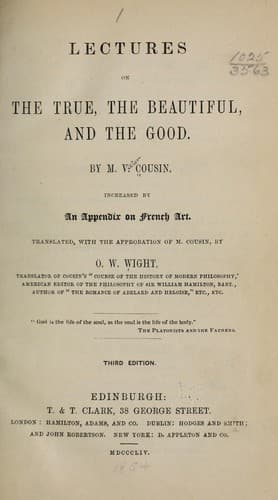
Lectures on the true, the beautiful and the goodCousin, Victor
Philosophy
Lectures on the true, the beautiful and the good
Cousin, Victor
Aesthetics; Ethics; Truth
Since we have spoken somewhat extensively of painting, would it not be
unjust to pass in silence over engraving, its daughter, or its sister?
Certainly it is not an art of ordinary importance; we have excelled in
it; we have above all carried it to its perfection in portraits. Let us
be equitable to ourselves. What school--and we are not unmindful of
those of Marc' Antonio, Albert Durer, and Rembrandt--can present such a
succession of artists of this kind? Thomas de Leu and Leonard Gautier
make in some sort the passage from the sixteenth to the seventeenth
century. Then come a crowd of men of the most diverse talents,--Mellan,
Michel Lasne, Morin, Daret, Huret, Masson, Nanteuil, Drevet, Van
Schupen, the Poillys, the Edelincks, and the Audrans. Gerard Edelinck
and Nanteuil alone have a popular renown, and they merit it by the
delicacy, splendor, and charm of their graver. But the connoisseurs of
elevated taste find at least their rivals in engravers now less admired,
because they do not flatter the eye so much, but have, perhaps, more
truth and vigor. It must also be said, that the portraits of these two
masters have not the historic importance of those of their predecessors.
The _Conde_ of Nanteuil is justly admired; but if we wish to know the
great Conde, the conqueror of Rocroy and Lens, we must not demand him
from Nanteuil, but from Huret, Michel Lasne, and Daret,[160] who
designed and engraved him in all his force and heroic beauty. Edelinck
and Nanteuil himself scarcely knew and retraced the seventeenth century,
except at the approach of its decline.[161] Morin and Mellan were able
to see it, and transmit it in its glorious youth. Morin is the Champagne
of engraving: he does not engrave, he paints. It is he who represents
and transmits to posterity the illustrious men of the first half of the
great century--Henry IV., Louis XIII., the de Thous, Berulle, Jansenius,
Saint-Cyran, Marillac, Bentivoglio, Richelieu, Mazarin, still young,
and Retz, when he was only a coadjutor.[162] Mellan had the same
advantage. He is the first in date of all the engravers of the
seventeenth century, and perhaps is also the most expressive. With a
single line, it seems that from his hands only shades can spring; he
does not strike at first sight; but the more we regard him, the more he
seizes, penetrates, and touches, like Lesueur.[163]
Public-domain text, read in full here on John Shaqi.
Reviews
Reviews
No reviews yet
Be the first to share your thoughts on this work.
Elsewhere in the archive
Join the Discussion
Join the discussion
Sign in to leave a comment or review.
Sign InorCreate an account