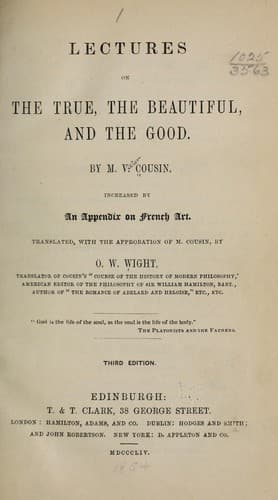
Lectures on the true, the beautiful and the goodCousin, Victor
Philosophy
Lectures on the true, the beautiful and the good
Cousin, Victor
Aesthetics; Ethics; Truth
Christianity, that is to say, the reign of the spirit, is favorable to
painting, is particularly expressive. Sculpture seems to be a pagan art;
for, if it must also contain moral expression, it is always under the
imperative condition of beauty of form. This is the reason why sculpture
is as it were natural to antiquity, and appeared there with an
incomparable splendor, before which painting somewhat paled,[164] whilst
among the moderns it has been eclipsed by painting, and has remained
very inferior to it, by reason of the extreme difficulty of bringing
stone and marble to express Christian sentiment, without which, material
beauty suffers; so that our sculpture is too insignificant to be
beautiful, too mannered to be expressive. Since antiquity, there have
scarcely been two schools of sculpture:[165]--one at Florence, before
Michael Angelo, and especially with Michael Angelo; the other in
France, at the _Renaissance_, with Jean Cousin, Goujon, Germain Pilon.
We may say that these three artists have, as it were, shared among
themselves grandeur and grace: to the first belong nobility and force,
with profound knowledge;[166] to the other two, an elegance full of
charm. Sculpture changes its character in the seventeenth century as
well as every thing else: it no longer has the same attraction, but it
finds moral and religious inspiration, which the skilful masters of the
_Renaissance_ too much lacked. Jean Cousin excepted, is there one of
them that is superior to Jacques Sarazin? That great artist, now almost
forgotten, is at once a disciple of the French school and the Italian
school, and to the qualities that he borrows from his predecessors, he
adds a moral expression, touching and elevated, which he owes to the
spirit of the new school. He is, in sculpture, the worthy contemporary
of Lesueur and Poussin, of Corneille, Descartes, and Pascal. He belongs
entirely to the reign of Louis XIII., Richelieu, and Mazarin; he did not
even see that of Louis XIV.[167] Called into France by Richelieu, who
had also called there Poussin and Champagne, Jacques Sarazin in a few
years produced a multitude of works of rare elegance and great
character. What has become of them? The eighteenth century passed over
them without regarding them. The barbarians that destroyed or scattered
them, were arrested before the paintings of Lesueur and Poussin,
protected by a remnant of admiration: while breaking the master-pieces
of the French chisel, they had no suspicion of the sacrilege they were
committing against art as well as their country. I was at least able to
see, some years ago, at the Museum of French Monuments, collected by the
piety of a friend of the arts, beautiful parts of a superb mausoleum
erected to the memory of Henri de Bourbon, second of the name, Prince of
Conde, father of the great Conde, the worthy support, the skilful
fellow-laborer of Richelieu and Mazarin. This monument was supported by
Public-domain text, read in full here on John Shaqi.
Reviews
Reviews
No reviews yet
Be the first to share your thoughts on this work.
Elsewhere in the archive
Join the Discussion
Join the discussion
Sign in to leave a comment or review.
Sign InorCreate an account