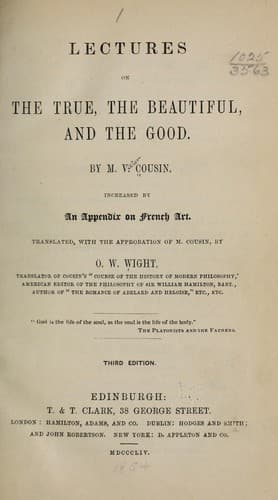
Lectures on the true, the beautiful and the goodCousin, Victor
Philosophy
Lectures on the true, the beautiful and the good
Cousin, Victor
Aesthetics; Ethics; Truth
In truth, I wonder that men now dare speak so lightly of Puget and
Girardon. To Puget qualities of the first order cannot be refused. He
has the fire, the enthusiasm, the fecundity of genius. The caryatides of
the Hotel de Ville of Toulon, which have been brought to the Museum of
Paris, attest a powerful chisel. The _Milon_ reminds one of the manner
of Michael Angelo; it is a little overstrained, but it cannot be denied
that the effect is striking. Do you want a talent more natural, and
still having force and elevation? Take the trouble to search in the
Tuileries, in the gardens of Versailles, in several churches of Paris,
for the scattered works of Girardon, here for the mausoleum of the
Gondis,[175] there for that of the Castellans,[176] that of
Louvois,[177] etc.; especially go to see in the church of the Sorbonne
the mausoleum of Richelieu. The formidable minister is there represented
in his last moments, sustained by religion and wept by his country. The
whole person is of a perfect nobility, and the figure has the fineness,
the severity, the superior distinction given to it by the pencil of
Champagne, and the gravers of Morin, Michel Lasne, and Mellan.
Finally, I do not regard as a vulgar sculptor Coysevox, who, under the
influence of Lebrun, unfortunately begins the theatrical style, who
still has the facility, movement, and elegance of Lebrun himself. He
reared worthy monuments to Mazarin, Colbert, and Lebrun,[178] and thus
to speak, sowed busts of the illustrious men of his time. For, remark it
well, artists then took scarcely any arbitrary and fanciful subjects.
They worked upon contemporaneous subjects, which, while giving them
proper liberty, inspired and guided them, and communicated a public
interest to their works. The French sculpture of the seventeenth
century, like that of antiquity, is profoundly natural. The churches and
the monasteries were filled with the statues of those who loved them
during life, and wished to rest in them after death. Each church of
Paris was a popular museum. The sumptuous residences of the
aristocracy--for at that period, there was one in France, like that of
England at the present time--possessed their secular tombs, statues,
busts, and portraits of eminent men whose glory belonged to the country
as well as their own family. On its side, the state did not encourage
the arts in detail, and, thus to speak, in a small way; it gave them a
powerful impulse by demanding of them important works, by confiding to
them vast enterprises. All great things were thus mingled together,
reciprocally inspired and sustained each other.
Public-domain text, read in full here on John Shaqi.
Reviews
Reviews
No reviews yet
Be the first to share your thoughts on this work.
Elsewhere in the archive
Join the Discussion
Join the discussion
Sign in to leave a comment or review.
Sign InorCreate an account