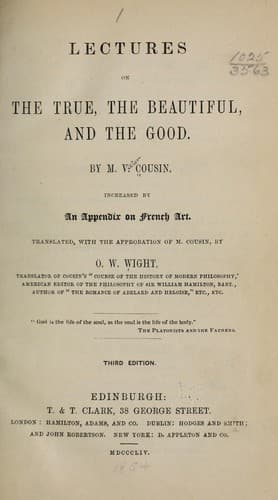
Lectures on the true, the beautiful and the goodCousin, Victor
Philosophy
Lectures on the true, the beautiful and the good
Cousin, Victor
Aesthetics; Ethics; Truth
One man alone in Europe has left a name in the beautiful art that
surrounds a chateau or a palace with graceful gardens or magnificent
parks,--that man is a Frenchman of the seventeenth century, is Le Notre.
Le Notre may be reproached with a regularity that is perhaps excessive,
and a little mannerism in details; but he has two qualities that
compensate for many defects, grandeur and sentiment. He who designed the
park of Versailles, who to the proper arrangement of parterres, to the
movement of fountains, to the harmonious sound of waterfalls, to the
mysterious shades of groves, has known how to add the magic of infinite
perspective by means of that spacious walk where the view is extended
over an immense sheet of water to be lost in the limitless
distances,--he is a landscape-painter worthy of having a place by the
side of Poussin and Lorrain.
We had in the middle age our Gothic architecture, like all the nations
of northern Europe. In the sixteenth century what architects were Pierre
Lescot, Jean Bullant, and Philibert Delorme! What charming palaces, what
graceful edifices, the Tuileries, the Hotel de Ville of Paris, Chambord,
and Ecouen! The seventeenth century also had its original architecture,
different from that of the middle age and that of the _Renaissance_,
simple, austere, noble, like the poetry of Corneille and the prose of
Descartes. Study without scholastic prejudice the Luxembourg of de
Brosses,[179] the portal of Saint-Gervais, and the great hall of the
Palais de Justice, by the same architect; the Palais Cardinal and the
Sorbonne of Lemercier;[180] the cupola of Val-de-Grace by Lemuet;[181]
the triumphal arch of the Porte Saint-Denis by Francois Blondel;
Versailles, and especially the Invalides, of Mansart.[182] Consider with
attention the last edifice, let it make its impression on your mind and
soul, and you will easily succeed in recognizing in it a particular
beauty. It is not a Gothic monument, neither is it an almost Pagan
monument of the sixteenth century,--it is modern, and also Christian; it
is vast with measure, elegant with gravity. Contemplate at sunset that
cupola reflecting the last rays of day, elevating itself gently towards
the heavens in a slight and graceful curve; cross that imposing
esplanade, enter that court admirably lighted in spite of its covered
galleries, bow beneath the dome of that church where Vauban and Turenne
sleep,--you will not be able to guard yourself from an emotion at once
religious and military; you will say to yourself that this is indeed the
asylum of warriors who have reached the evening of life and are prepared
for eternity!
Public-domain text, read in full here on John Shaqi.
Reviews
Reviews
No reviews yet
Be the first to share your thoughts on this work.
Elsewhere in the archive
Join the Discussion
Join the discussion
Sign in to leave a comment or review.
Sign InorCreate an account