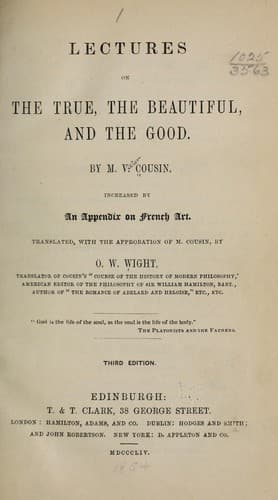
Lectures on the true, the beautiful and the goodCousin, Victor
Philosophy
Lectures on the true, the beautiful and the good
Cousin, Victor
Aesthetics; Ethics; Truth
admirably appropriated to their object, wherein appears so well the hand
of the century and the country which reared them!
While architecture thus strays, it is natural that painting should seek
above every thing color and brilliancy, that sculpture should apply
itself to become Pagan again, that poetry itself, receding for two
centuries, should abjure the worship of thought for that of fancy, that
it should everywhere go borrowing images from Spain, Italy, and Germany,
that it should run after subaltern and foreign qualities which it will
not attain, and abandon the grand qualities of the French genius.
It will be said that the Christian sentiment which animated Lesueur and
the artists of the seventeenth century is wanting to those of ours; it
is extinguished, and cannot be rekindled. In the first place, is that
very certain? Native faith is dead, but cannot reflective faith take its
place? Christianity is exhaustless; it has infinite resources, and
admirable flexibility; there are a thousand ways of arriving at it and
returning to it, because it has itself a thousand phases that answer to
the most different dispositions, to all the wants, to all the mobility
of the heart. What it loses on one side, it gains on another; and as it
has produced our civilization, it is called to follow it in all its
vicissitudes. Either every religion will perish in this world, or
Christianity will endure, for it is not in the power of thought to
conceive a more perfect religion. Artists of the nineteenth century, do
not despair of God and yourselves. A superficial philosophy has thrown
you far from Christianity considered in a strict sense; another
philosophy can bring you near it again by making you see it with another
eye. And then, if the religious sentiment is weakened, are there not
other sentiments that can make the heart of man beat, and fecundate
genius? Plato has said, that beauty is always old and always new. It is
superior to all its forms, it belongs to all countries and all times; it
belongs to all beliefs, provided these beliefs be serious and profound,
and the need be felt of expressing and spreading them. If, then, we have
not arrived at the boundary assigned to the grandeur of France, if we
are not beginning to descend into the shade of death, if we still truly
live, if there remain to us convictions, of whatever kind they may be,
thereby even remains to us, or at least may remain to us, what made the
glory of our fathers, what they did not carry with them to the tomb,
what had already survived all revolutions, Greece, Rome, the Middle Age,
what does not belong to any temporary or ephemeral accident, what
subsists and is continually found in the focus of consciousness--I mean
moral inspiration, immortal as the soul.
Public-domain text, read in full here on John Shaqi.
Reviews
Reviews
No reviews yet
Be the first to share your thoughts on this work.
Elsewhere in the archive
Join the Discussion
Join the discussion
Sign in to leave a comment or review.
Sign InorCreate an account