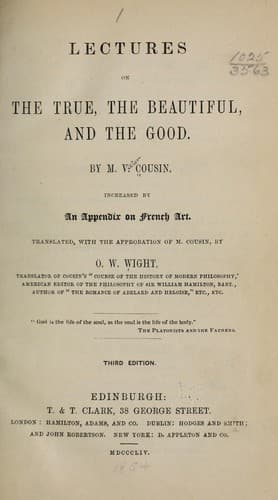
Lectures on the true, the beautiful and the goodCousin, Victor
Philosophy
Lectures on the true, the beautiful and the good
Cousin, Victor
Aesthetics; Ethics; Truth
Let us terminate here, and sum up this defence of the national art.
There are in arts, as well as in letters and philosophy, two contrary
schools. One tends to the ideal in all things,--it seeks, it tries to
make appear the spirit concealed under the form, at once manifested and
veiled by nature; it does not so much wish to please the senses and
flatter the imagination as to enlarge the intellect and move the soul.
The other, enamored of nature, stops there and devotes itself to
imitation,--its principal object is to reproduce reality, movement,
life, which are for it the supreme beauty. The France of the seventeenth
century, the France of Descartes, Corneille, and Bossuet, highly
spiritual in philosophy, poetry, and eloquence, was also highly
spiritual in the arts. The artists of that great epoch participate in
its general character, and represent it in their way. It is not true
that they lacked imagination, more than Pascal and Bossuet lacked it.
But inasmuch as they do not suffer imagination to usurp the dominion
that does not belong to it, inasmuch as they subject its order, even its
impetuosity, to the reign of reason and the inspirations of the heart,
it seems that it is not so strong when it is only disciplined and
regulated. As we have said, they excel in composition, especially in
expression. They always have a thought, and a moral and elevated
thought. For this reason they are dear to us, their cause interests us,
is in some sort our own cause, and so this homage rendered to their
misunderstood glory naturally crowns these lectures devoted to true
beauty, that is to say, moral beauty.
May these lectures be able to make it known, and, above all, loved! May
they be able also to inspire some one of you with the idea of devoting
himself to studies so beautiful, of devoting to them his life, and
attaching to them his name! The sweetest recompense of a professor who
is not too unworthy of that title, is to see rapidly following in his
footsteps young and noble spirits who easily pass him and leave him far
behind them.[186]
FOOTNOTES:
[128] One is reminded of the expression of the great Conde: "Where then
has Corneille learned politics and war?"
[129] It would be a curious and useful study, to compare with the
original all the passages of Britannicus imitated from Tacitus; in them
Racine would almost always be found below his model. I will give a
single example. In the account of the death of Britannicus, Racine thus
expresses the different effects of the crime on the spectators:
Juez combien ce coup frappe tous les esprits;
La moitie s'epouvante et sort avec des cris;
Mais ceux qui de la cour ont un plus long usage
Sur les yeux de Cesar composent leur visage.
Public-domain text, read in full here on John Shaqi.
Reviews
Reviews
No reviews yet
Be the first to share your thoughts on this work.
Elsewhere in the archive
Join the Discussion
Join the discussion
Sign in to leave a comment or review.
Sign InorCreate an account