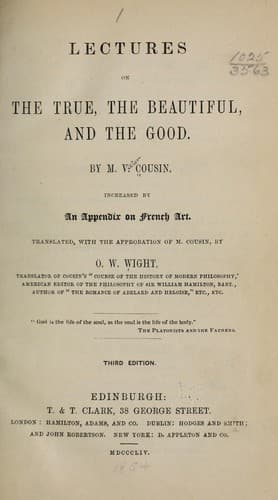
Lectures on the true, the beautiful and the goodCousin, Victor
Philosophy
Lectures on the true, the beautiful and the good
Cousin, Victor
Aesthetics; Ethics; Truth
[146] Well appreciated by Richelieu, he preferred his esteem to his
benefits. One day when an envoy of Richelieu said to him that he had
only to ask freely what he wished for the advancement of his fortune,
Champagne responded that if M. the Cardinal could make him a more
skilful painter than he was, it was the only thing that he asked of his
Eminence; but that being impossible, he only desired the honor of his
good graces. Felibien, _Entretiens_, 1st edition, 4to., part v., p. 171;
and de Piles, _Abrege de la Vie des Peintres_, 2d edition, p. 500.--"As
he had much love for justice and truth, provided he satisfied what they
both demanded, he easily passed over all the rest."--_Necrologe de
Port-Royal_, p. 336.
[147] See the APPENDIX.
[148] The original is in the Museum of Grenoble; but see the engraving
of Morin; see also that of Daret, after the beautiful design of
Demonstier.
[149] In the Museum of the Louvre; see also the engraving of Morin.
[150] The original is now in the Chateau of Sable, belonging to the
Marquis of Rouge; see the engraving of Simonneau in Perrault. The
beautiful engraving of Edelinck was made after a different original,
attributed to a nephew of Champagne.
[151] The original is also in the possession of the Marquis of Rouge;
the admirable engraving of Van Schupen may take its place.
[152] In the Museum.
[153] In the Museum, and engraved by Gerard Edelinck.
[154] _La Gloire du Val-de-Grace_, in 4to, 1669, with a frontispiece and
vignettes. Moliere there enters into infinite details on all the parts
of the art of painting and the genius of Mignard. He pushes eulogy
perhaps to the extent of hyperbole; afterwards, hyperbole gave place to
the most shameful indifference. The fresco of the dome of Val-de-grace
is composed of four rows of figures, which rise in a circle from the
base to the vertex of the arch. In the upper part is the Trinity, above
which is raised a resplendent sky. Below the Trinity are the celestial
powers. Descending a degree, we see the Virgin and the holy personages
of the Old and New Testament. Finally, at the lower extremity is Anne of
Austria, introduced into paradise by St. Anne and St. Louis, and these
three figures are accompanied by a multitude of personages pertaining to
the history of France, among whom are distinguished Joan of Arc,
Charlemagne, etc.
[155] Engraved by Gerard Audran under the name of the _Plague of David_
(_la Peste de David_). What has become of the original?
[156] See his _Landscape at Sunset_, and the _Bathers_ (_les
Baigneuses_), an agreeable scene somewhat blemished by careless drawing.
[157] It would be necessary to cite all his compositions. In his _Holy
Family_ the figure of the Virgin, without being celestial, admirably
expresses meditation and reflection. We lost some time ago the most
important work of S. Bourdon, the _Sept Oeuvres de Misericorde_. See
the APPENDIX.
[158] See especially his _Extreme Unction_.
Public-domain text, read in full here on John Shaqi.
Reviews
Reviews
No reviews yet
Be the first to share your thoughts on this work.
Elsewhere in the archive
Join the Discussion
Join the discussion
Sign in to leave a comment or review.
Sign InorCreate an account