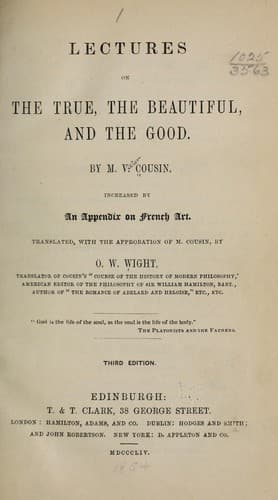
Lectures on the true, the beautiful and the goodCousin, Victor
Philosophy
Lectures on the true, the beautiful and the good
Cousin, Victor
Aesthetics; Ethics; Truth
[159] The picture that is called _le Silence_, which represents the
sleep of the infant Jesus, is not unworthy of Poussin. The head of the
infant is of superhuman power. The _Battles of Alexander_, with their
defects, are pages of history of the highest order; and in the
_Alexander visiting with Ephestion the Mother and the Wife of Darius_,
one knows not which to admire most, the noble ordering of the whole or
the just expression of the figures.
[160] It seems that Lesueur sometimes furnished Daret with designs. It
is indeed to Lesueur that Daret owes the idea and the design of his
_chef-d'oeuvre_, the portrait of Armand de Bourbon, prince de Conti,
represented in his earliest youth, and in an abbe, sustained and
surrounded by angels of different size, forming a charming composition.
The drawing is completely pure, except some imperfect fore-shortenings.
The little angels that sport with the emblems of the future cardinal are
full of spirit, and, at the same time, sweetness.
[161] Edelinck saw only the reign of Louis XIV. Nanteuil was able to
engrave very few of the great men of the time of Louis XIII., and the
regency, and in the latter part of their life; Mazarin, in his last five
or six years; Conde, growing old; Turenne, old; Fouquet and Matthieu
Mole, some years before the fall of the one and the death of the other;
and he was too often obliged to waste his talent upon a crowd of
parliamentarians, ecclesiastics, and obscure financiers.
[162] If I wished to make any one acquainted with the greatest and most
neglected portion of the seventeenth century, that which Voltaire almost
wholly omitted, I would set him to collecting the works of Morin.
[163] Mellan not only made portraits after the celebrated painters of
his time, he is himself the author of great and charming compositions,
many of which serve as frontispieces to books. I willingly call
attention to that one which is at the head of a folio edition of the
_Introduction a la Vie Devote_, and to the beautiful frontispieces of
the writings of Richelieu, from the press of the Louvre.
[164] This was the opinion of Winkelmann at the end of the eighteenth
century; it is our opinion now, even after all the discoveries that have
been made during fifty years, that may be seen in great part retraced
and described in the _Musio real Barbonico_.
[165] There was doubtless sculpture in the middle age: the innumerable
figures at the portals of our cathedrals, and the statues that are
discovered every day sufficiently testify it. The _imagers_ of that time
certainly had much spirit and imagination; but, at least in everything
that we have seen, beauty is absent, and taste wanting.
[166] Go and see at the Museum of Versailles the statue of Francis I.,
and say whether any Italian, except the author of the _Laurent de
Medicis_, has made any thing like it. See also in the Museum of the
Louvre, the statue of Admiral Chabot.
Public-domain text, read in full here on John Shaqi.
Reviews
Reviews
No reviews yet
Be the first to share your thoughts on this work.
Elsewhere in the archive
Join the Discussion
Join the discussion
Sign in to leave a comment or review.
Sign InorCreate an account