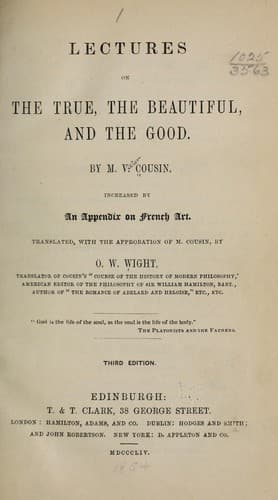
Lectures on the true, the beautiful and the goodCousin, Victor
Philosophy
Lectures on the true, the beautiful and the good
Cousin, Victor
Aesthetics; Ethics; Truth
[186] In the first rank of the intelligent auditors of this course was
M. Jouffroy, who already under our auspices, had presented to the
_faculte des lettres_, in order to obtain the degree of doctor, a thesis
on the beautiful. M. Jouffroy had cultivated, with care and particular
taste, the seeds that our teaching might have planted in his mind. But
of all those who at that epoch or later frequented our lectures, no one
was better fitted to embrace the entire domain of beauty or art than the
author of the beautiful articles on Eustache Lesueur, the Cathedral of
Noyon, and the Louvre. M. Vitet possesses all the knowledge, and, what
is more, all the qualities requisite for a judge of every kind of
beauty, for a worthy historian of art. I yield to the necessity of
addressing to him the public petition that he may not be wanting to a
vocation so marked and so elevated.
PART THIRD
THE GOOD.
LECTURE XI.
PRIMARY NOTIONS OF COMMON SENSE.
Extent of the question of the good.--Position of the question
according to the psychological method: What is, in regard to the
good, the natural belief of mankind?--The natural beliefs of
humanity must not be sought in a pretended state of
nature.--Study of the sentiments and ideas of men in languages,
in life, in consciousness.--Disinterestedness and
devotedness.--Liberty.--Esteem and
contempt.--Respect.--Admiration and
indignation.--Dignity.--Empire of opinion.--Ridicule.--Regret
and repentance.--Natural and necessary foundations of all
justice.--Distinction between fact and right.--Common sense,
true and false philosophy.
The idea of the true in its developments, comprises psychology, logic,
and metaphysics. The idea of the beautiful begets what is called
aesthetics. The idea of the good is the whole of ethics.
It would be forming a false and narrow idea of ethics to confine them
within the inclosure of individual consciousness. There are public
ethics, as well as private ethics, and public ethics embrace, with the
relations of men among themselves, so far as men, their relations as
citizens and as members of a state. Ethics extend wherever is found in
any decree the idea of the good. Now, where does this idea manifest
itself more, and where do justice and injustice, virtue and crime,
heroism and weakness appear more openly, than on the theatre of civil
life? Moreover, is there any thing that has a more decisive influence
over manners, even of individuals, than the institutions of peoples and
the constitutions of states? If the idea of the good goes thus far, it
must be followed thither, as recently the idea of the beautiful has
introduced us into the domain of art.
Public-domain text, read in full here on John Shaqi.
Reviews
Reviews
No reviews yet
Be the first to share your thoughts on this work.
Elsewhere in the archive
Join the Discussion
Join the discussion
Sign in to leave a comment or review.
Sign InorCreate an account