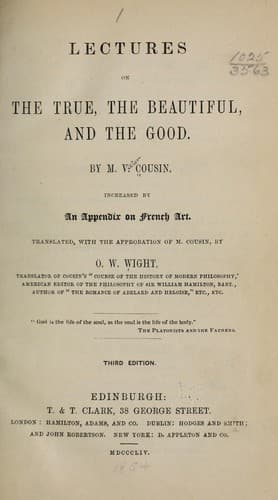
Lectures on the true, the beautiful and the goodCousin, Victor
Philosophy
Lectures on the true, the beautiful and the good
Cousin, Victor
Aesthetics; Ethics; Truth
Philosophy usurps no foreign power; but it is not disposed to relinquish
its right of examination over all the great manifestations of human
nature. All philosophy that does not terminate in ethics, is hardly
worthy of the name, and all ethics that do not terminate at least in
general views on society and government, are powerless ethics, that have
neither counsels nor rules to give humanity in its most difficult
trials.
It seems that at the point where we have arrived, the metaphysics and
aesthetics that we have taught evidently involve such a doctrine of
morality and not such another, that, accordingly, the question of the
good, that question so fertile and so vast, is for us wholly solved, and
that we can deduce, by way of reasoning, the moral theory that is
derived from our theory of the beautiful and our theory of the true. We
might do this, perhaps, but we will not. This would be abandoning the
method that we have hitherto followed, that method that proceeds by
observation, and not by deduction, and makes consulting experience a law
to itself. We do not grow weary of experience. Let us attach ourselves
faithfully to the psychological method; it has its delays; it condemns
us to more than one repetition, but it places us in the beginning, and a
long time retains us at the source of all reality, and all light.
The first maxim of the psychological method is this: True philosophy
invents nothing, it establishes and describes what is. Now here, what
is, is the natural and permanent belief of the being that we are
studying, to wit, man. What is, then, in relation to the good, the
natural and permanent belief of the human race? Such is, in our eyes,
the first question.
With us, in fact, the human race does not take one side, and philosophy
the other. Philosophy is the interpreter of the human race. What the
human race thinks and believes, often unconsciously, philosophy
re-collects, explains, establishes. It is the faithful and complete
expression of human nature, and human nature is entire in each of us
philosophers, and in every other man. Among us, it is attained by
consciousness; among other men, it manifests itself in their words and
actions. Let us, then, interrogate the latter and the former; let us
especially interrogate our own consciousness; let us clearly recognize
what the human race thinks; we shall then see what should be the office
of philosophy.
Is there a human language known to us that has not different expressions
for good and evil, for just and unjust? Is there any language, in which,
by the side of the words pleasure, interest, utility, happiness, are not
also found the words sacrifice, disinterestedness, devotedness, virtue?
Do not all languages, as well as all nations, speak of liberty, duty,
and right?
Public-domain text, read in full here on John Shaqi.
Reviews
Reviews
No reviews yet
Be the first to share your thoughts on this work.
Elsewhere in the archive
Join the Discussion
Join the discussion
Sign in to leave a comment or review.
Sign InorCreate an account