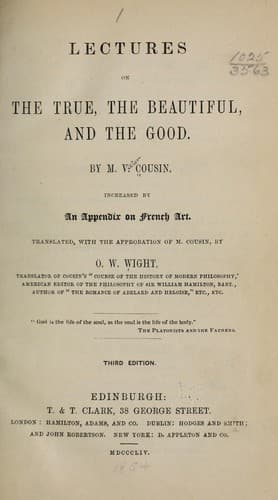
Lectures on the true, the beautiful and the goodCousin, Victor
Philosophy
Lectures on the true, the beautiful and the good
Cousin, Victor
Aesthetics; Ethics; Truth
Consult the annals of the human race, and you will find in them man
everywhere, and more and more, claiming his liberty. This word liberty
is as old as man himself. What then! Men wish to be free, and man
himself should not be free! The word nevertheless exists with the most
determined signification. It signifies that man believes himself a free
being, not only animated and sensible, but endowed with will, a will
that belongs to him, that consequently cannot admit over itself the
tyranny of another will which would make, in regard to him, the office
of fatality, even were it that of the most beneficent fatality. Do you
suppose that the word liberty could ever have been formed, if the thing
itself did not exist? None but a free being could possess the idea of
liberty. Will it be said that the liberty of man is only an illusion?
The wishes of the human race are then the most inexplicable
extravagance. In denying the essential distinction between liberty and
fatality, we contradict all languages and all received notions; we have,
it is true, the advantage of absolving tyrants, but we degrade heroes.
They have, then, fought and died for a chimera!
All languages contain the words esteem and contempt. To esteem, to
despise,--these are universal expressions, certain phenomena, from which
an impartial analysis can draw the highest notions. Can we despise a
being who, in his acts, should not be free, a being who should not know
the good, and should not feel himself obligated to fulfil it? Suppose
that the good is not essentially different from the evil, suppose that
there is in the world only interest more or less well understood, that
there is no real duty, and that man is not essentially a free being,--it
is impossible to explain rationally the word contempt. It is the same
with the word esteem.
Esteem is a fact which, faithfully expressed, contains a complete
philosophy as solid as generous. Esteem has two certain characters: 1st,
It is a disinterested sentiment in the soul of him who feels it; 2d, It
is applied only to disinterested acts. We do not esteem at will, and
because it is our interest to esteem. Neither do we esteem an action or
a person because they have been successful. Success, fortunate
calculation, may make us envied; it does not bring esteem, which has
another price.
Esteem in a certain degree, and under certain circumstances, is
respect,--respect, a holy and sacred word which the most subtile or the
loosest analysis will never degrade to expressing a sentiment that is
related to ourselves, and is applied to actions crowned by fortune.
Take again these two words, these two facts analogous to the first two,
admiration and indignation. Esteem and contempt are rather judgments;
indignation and admiration are sentiments, but sentiments that pertain
to intelligence and envelop a judgment.[189]
Public-domain text, read in full here on John Shaqi.
Reviews
Reviews
No reviews yet
Be the first to share your thoughts on this work.
Elsewhere in the archive
Join the Discussion
Join the discussion
Sign in to leave a comment or review.
Sign InorCreate an account