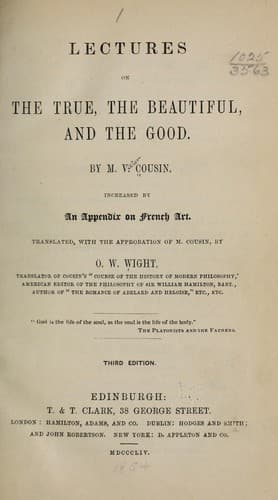
Lectures on the true, the beautiful and the goodCousin, Victor
Philosophy
Lectures on the true, the beautiful and the good
Cousin, Victor
Aesthetics; Ethics; Truth
analysis, we turn our eyes from infancy and the savage state, in order
to direct them towards the being who is the sole object of our studies,
the actual man, the real and completed man.
Do you know a language, a people, which does not possess the word
disinterested virtue? Who is especially called an honest man? Is it the
skilful calculator, devoting himself to making his own affairs the best
possible, or he who, under all circumstances, is disposed to observe
justice against his apparent or real interest? Take away the idea that
an honest man is capable, to a certain degree, of resisting the
attractions of personal interest, and of making some sacrifices for
opinion, for propriety, for that which is or appears honest, and you
take away the foundation of that title of honest man, even in the most
ordinary sense. That disposition to prefer what is good to our pleasure,
to our personal utility, in a word, to interest--that disposition more
or less strong, more or less constant, more or less tested, measures the
different degrees of virtue. A man who carries disinterestedness as far
as devotion, is called a hero, let him be concealed in the humblest
condition, or placed on a public stage. There is devotedness in obscure
as well as in exalted stations. There are heroes of probity, of honor,
of loyalty, in the relations of ordinary life, as well as heroes of
courage and patriotism in the counsels of peoples and at the head of
armies. All these names, with their meaning well recognized, are in all
languages, and constitute a certain and universal fact. We may explain
this fact, but on one imperative condition, that in explaining we do not
destroy it. Now, is the idea and the word disinterestedness explained to
us by reducing disinterestedness to interest? This is what common sense
invincibly repels.
Poets have no system,--they address themselves to men as they really
are, in order to produce in them certain effects. Is it skilful
selfishness or disinterested virtue that poets celebrate? Do they demand
our applause for the success of fortunate address, or for the voluntary
sacrifices of virtue? The poet knows that there is at the foundation of
the human soul I know not what marvellous power of disinterestedness and
devotedness. In addressing himself to this instinct of the heart, he is
sure of awakening a sublime echo, of opening every source of the
pathetic.
Public-domain text, read in full here on John Shaqi.
Reviews
Reviews
No reviews yet
Be the first to share your thoughts on this work.
Elsewhere in the archive
Join the Discussion
Join the discussion
Sign in to leave a comment or review.
Sign InorCreate an account